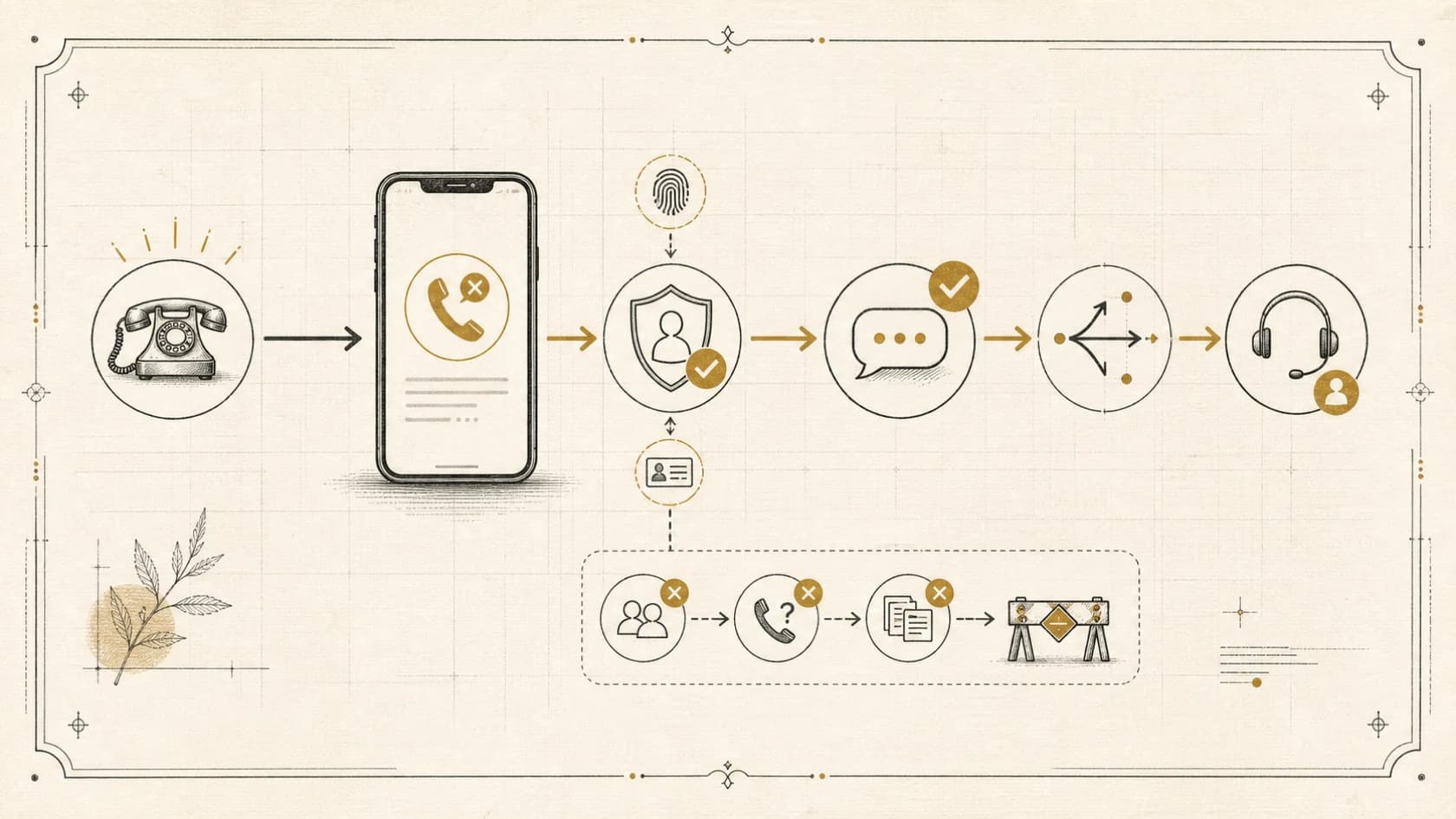
Missed-call text-back software can close a real gap: a prospect calls, nobody answers, and the business immediately acknowledges the attempt while the need is still current.
The feature is easy to demonstrate. The operating details determine whether it helps. A missed call may come from a new prospect, an existing customer, a vendor, a wrong number, a landline, a shared phone, a safety-sensitive situation, or somebody who called several times because the first response failed.
The system must do more than turn a phone event into a text. It needs to establish enough context, respect communication rules, route replies, prevent duplicates, and create accountable follow-up.
1. Decide which missed calls qualify
Do not attach one automation to every unanswered event. Define the numbers, hours, call outcomes, caller states, and exclusions that permit a response.
| Situation | Default behavior | Reason |
|---|---|---|
| New caller during business hours | Send approved acknowledgment if the number is text-capable and permitted | Creates a clear path to continue |
| New caller after hours | Use the approved after-hours message and expectation | Avoids implying live availability |
| Existing customer | Route according to account or support policy | A sales-style message can damage context |
| Repeated calls in a short window | Suppress duplicate texts and elevate urgency by rule | Prevents message bursts |
| Blocked, anonymous, or non-text-capable number | Use the defined no-text fallback | Delivery is not possible or identity is unclear |
| Emergency or safety line | Follow the exact emergency procedure | A marketing workflow is inappropriate |
| Known vendor, staff, or excluded contact | Suppress or use the published internal route | Avoids irrelevant outreach |
These conditions should be reviewable by operations, not hidden in a vendor’s default recipe.
2. Write a message that fits the evidence
The system knows a call was missed. It may know the dialed number, time, caller number, and a matched customer record. It does not automatically know the person’s name, intent, urgency, or preferred service.
The first message should acknowledge only what is known, identify the business, give a simple way to continue, and set an accurate expectation. It should not claim that a representative reviewed the request or promise a response time the team cannot support.
Personalization should fail safely. If identity matching is uncertain, use neutral language. Never include sensitive account details merely because a phone number appears to match a record; shared and recycled numbers exist.
Keep approved variants for business hours, after hours, existing customers, and any distinct service lines. Every variant needs an owner and change history.
3. Treat the reply as the beginning of work
Sending the text is the smallest part of the workflow. Someone must receive, understand, and act on the reply.
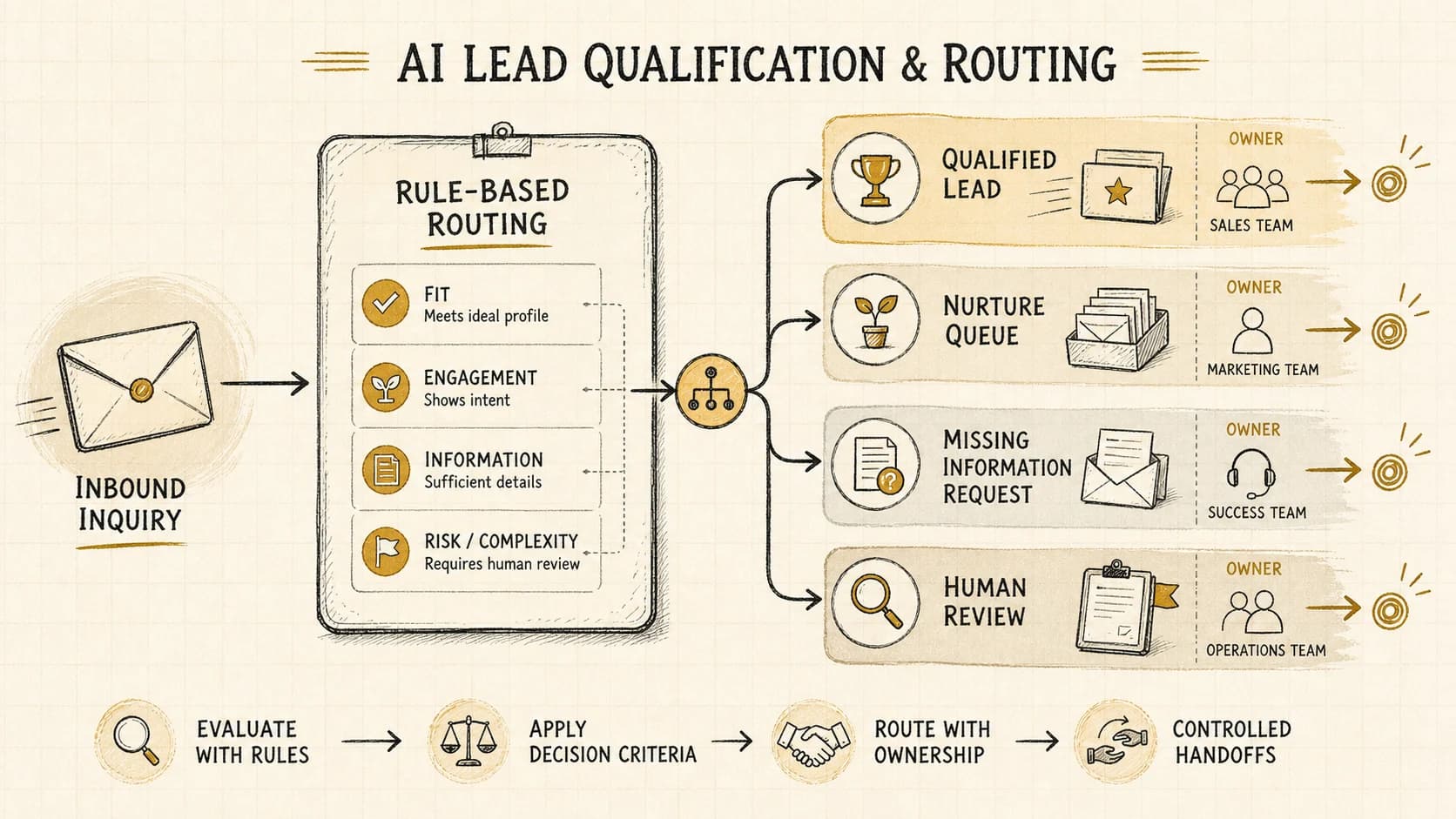
Define reply categories such as new-service inquiry, appointment request, existing-customer issue, stop request, wrong number, question requiring a person, and unclear intent. Map each category to an owner, visible queue, permitted answer, and fallback.
If AI classifies the reply, require evidence and confidence boundaries. An unclear or multi-intent reply should reach a person rather than be forced into the nearest sales category. The lead follow-up system guide explains how to preserve the original conversation, state, owner, and next action after that first response.
Two-way continuity matters. Staff should see the missed-call event and full message history in the tool they actually operate. A separate vendor inbox that nobody owns is not a response system.
4. Handle identity, consent, and opt-outs deliberately
Phone and messaging rules vary by jurisdiction, message type, and relationship. Obtain appropriate legal guidance for your situation; software settings are not a substitute for it.
Operationally, document the lawful basis and business rule for each message type, quiet hours, required identification, opt-out language, suppression lists, and record retention. Apply stop requests across connected systems, not only inside the text-back tool.
Do not infer broad marketing permission from one inbound call. Keep the immediate service response distinct from future promotional campaigns. The safest system makes that boundary explicit in data and workflow.
Identity matching also needs restraint. Exact phone matches can still represent a shared household, office, or reassigned number. Use a verification step before exposing account-specific information or changing records.
5. Prevent duplicate and contradictory outreach
A caller may leave voicemail, submit a form, send a chat, and call again. Separate automations can respond independently and create a confusing wall of messages.
Use a shared contact and conversation state where practical. Deduplicate by stable identifiers and time windows, but preserve ambiguous records for review rather than merging automatically. Check for an open conversation, appointment, support case, or owner action before sending.
Make every trigger idempotent. Replayed call events and delivery retries should not generate multiple texts. If the text provider times out, reconcile the delivery state before trying again.
6. Connect the text to the correct next action
The next action might be a callback task, a short intake, an approved booking path, an existing-customer route, or an emergency instruction. It is not always “book now.”
For a new inquiry, collect only what is needed to route the request. The AI receptionist guide provides a broader framework for intake and handoffs. If booking is allowed, use the rules in the AI appointment setter guide rather than exposing every calendar slot without qualification or preparation.
Record who owns the next step and what proves completion. A text conversation that ends with “someone will reach out” needs a task, due rule, backup, and visible exception if no one accepts it.
7. Test failure modes before turning it on
Test more than a successful mobile call. Include a landline, blocked number, repeated calls, existing customer, recycled or shared number, wrong number, opt-out, reply with several intents, media attachment, unsupported language, provider outage, CRM outage, duplicate event, and response just before a human callback.
Verify:
- the correct message was selected from current context;
- suppressed contacts received nothing;
- duplicates produced one coherent conversation;
- the original call and reply reached the correct record;
- ambiguous identity did not expose private information;
- a failed delivery or write entered an owned queue;
- a human could take over without making the caller repeat everything.
8. Measure the complete response loop
Useful operating measures include eligible missed calls, messages attempted and delivered, replies by category, time to owned next action, duplicate suppressions, opt-outs, wrong-number reports, unresolved conversations, failed writes, and human takeovers.
Compare these with the business’s prior baseline and review the actual conversations. Faster acknowledgment can be valuable, but it is not the same as qualified pipeline or completed service. Do not convert a software metric into a revenue claim without evidence from the full process.
9. Missed-call text-back checklist
Missed-call text-back software is a good narrow tool when the business can own the conversation it starts. If the real issue spans calls, texts, qualification, scheduling, and handoffs, the solution may require more than another isolated trigger. Apply for an assessment to identify the primary bottleneck and the most practical first move.