A lead follow-up system is not a sequence of automatic emails. It is the set of rules that keeps every valid inquiry attached to an owner, a current status, the relevant conversation history, and a permitted next action until the opportunity is resolved.
Automation helps when it makes that operating state more reliable. It hurts when it sends messages because time passed while ignoring a reply, an owner change, a customer relationship, or a promise already made.
For a professional-services business, context is the difference between useful persistence and an awkward message that tells the buyer nobody listened.
1. Define what “followed up” means
Teams often measure activity: calls made, emails sent, or tasks completed. Those signals do not prove the lead reached a meaningful next state.
Define the lifecycle in business terms. A simple model can begin with these states:
| State | Required evidence | Permitted next action |
|---|---|---|
| New | Valid inquiry and source captured | Assign owner and acknowledge receipt |
| Needs information | Specific decision cannot be made | Request only the missing facts |
| Qualified | Published fit conditions met | Offer the approved discovery or sales step |
| Waiting on prospect | Last useful message and due date recorded | Follow the approved cadence unless a stop condition occurs |
| Waiting internally | Named team decision or artifact required | Escalate to the internal owner, not the prospect |
| Nurture | Potential future fit with stated reason | Use the approved long-term path |
| Closed | Outcome and reason recorded | Stop active follow-up |
| Human review | Conflicting, sensitive, or novel situation | Pause automation and present context to the reviewer |
Every state needs an entry condition, owner, allowed actions, and exit condition. “Open” is too broad to operate.
2. Preserve one usable context record
The system should bring together what the next person needs without pretending every data source is equally authoritative.
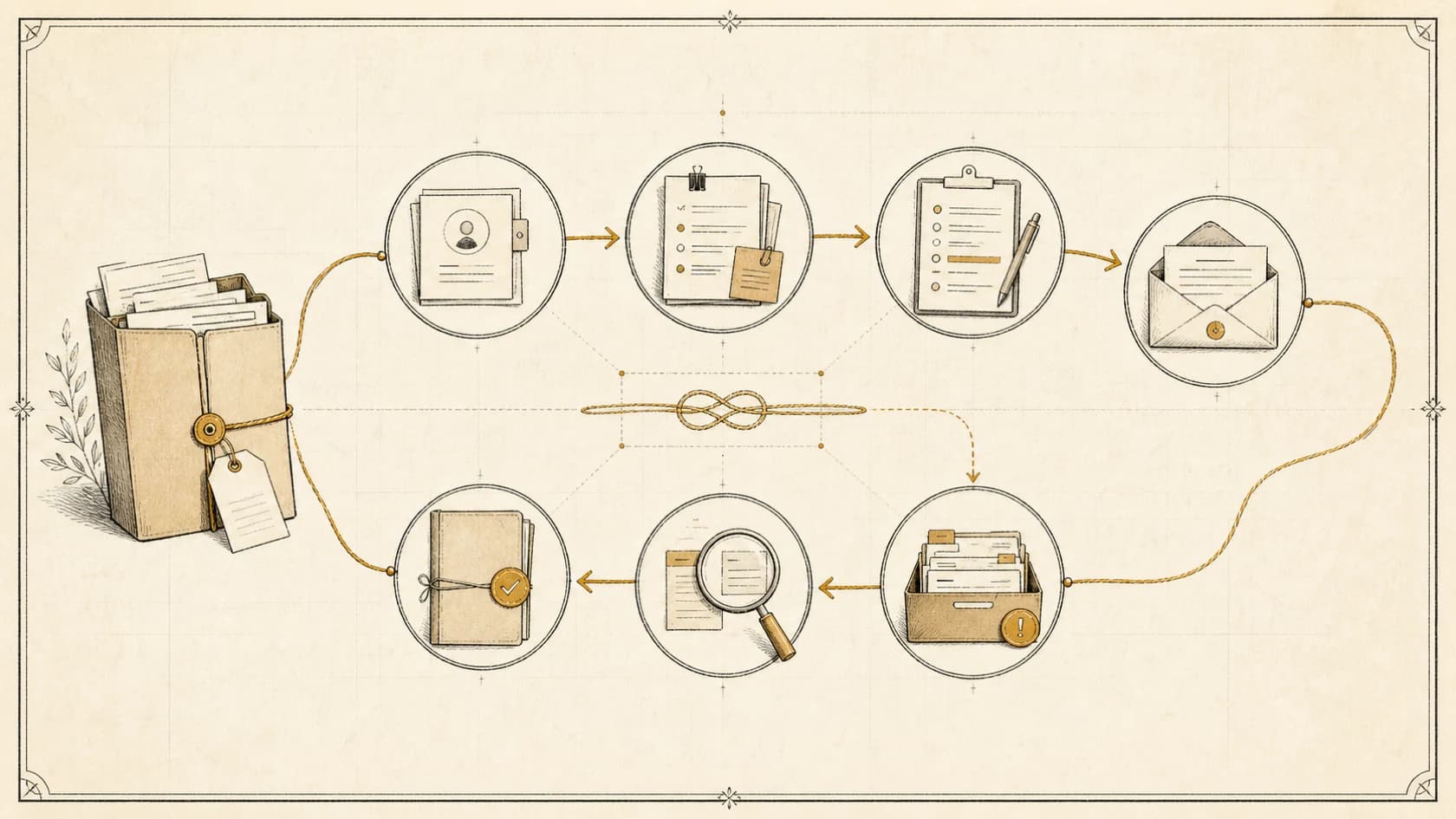
At minimum, preserve the original inquiry, channel, timestamps, contact and company identity, qualification facts, messages and call summaries, promises made, files requested or received, owner changes, and the current next action. Keep the raw source available when a summary could hide important wording.
Do not let automation overwrite a human note with a generated summary. Append changes with attribution. If two records may describe the same person or company, flag the possible match rather than silently merging sensitive histories.
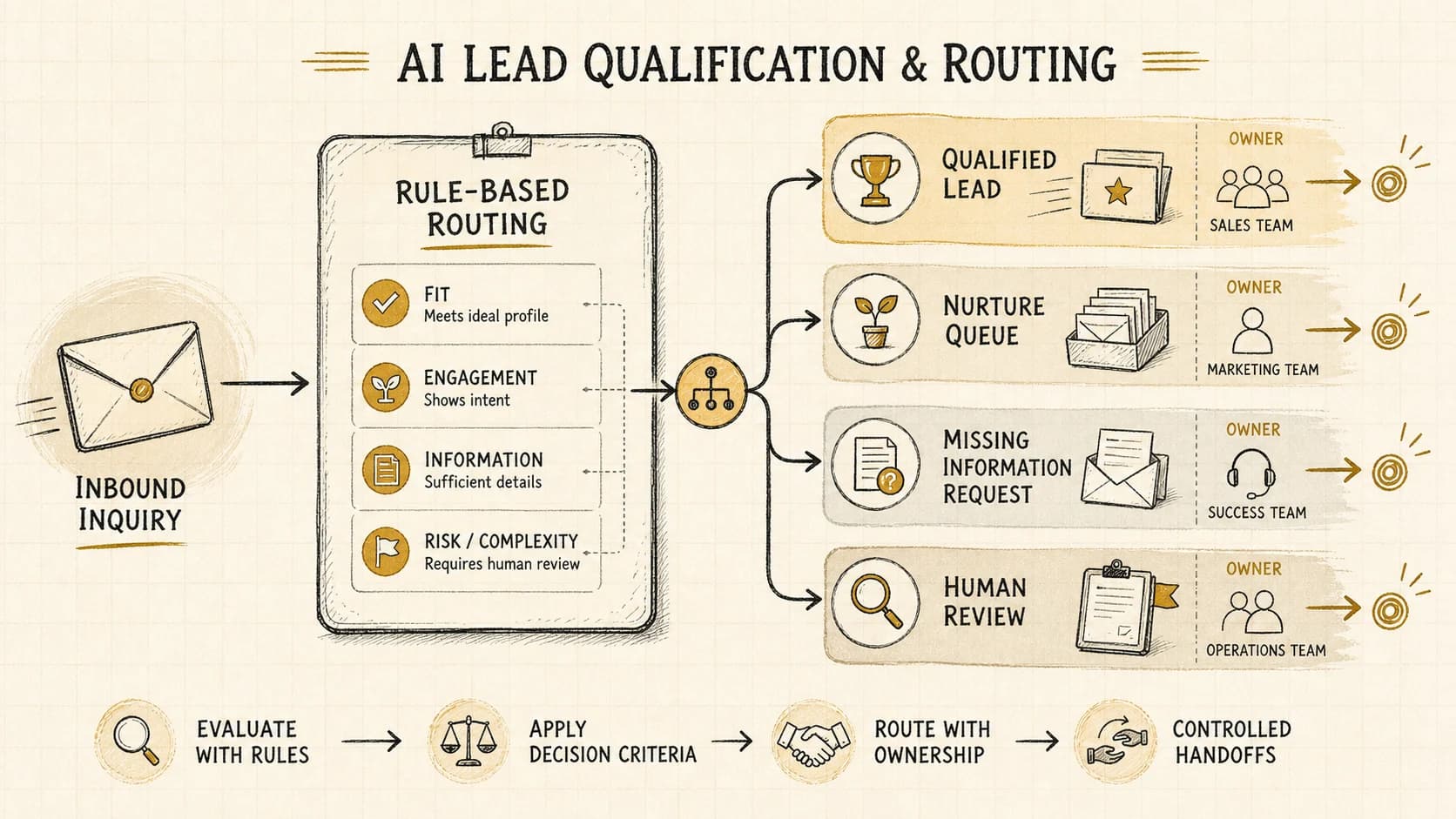
The lead qualification and routing guide provides the upstream rules. Follow-up should inherit the qualification reason and ownership decision instead of reconstructing them from scattered fields.
3. Separate cadence from decision logic
A cadence answers when a permitted action may occur. Decision logic answers whether that action is still appropriate.
Before any automated message, check:
- Is the record still in the expected state?
- Is the recipient identity and channel permitted?
- Has a reply, booking, opt-out, complaint, or owner action occurred?
- Is the message approved for this state and audience?
- Is the promised next step still accurate?
- Can the send be recorded and reconciled?
A delayed job should re-check current state immediately before sending. The fact that a message was scheduled yesterday is not permission to ignore what happened today.
Avoid treating a generic “no response” sequence as universal. A referral, former customer, urgent service inquiry, and early research question can require different language and ownership. The company—not the model—defines those differences.
4. Make ownership and next action inseparable
Every active lead should have one accountable owner and one explicit next action. A team or inbox can be a routing destination, but it still needs a rule for acceptance and escalation.
Record the next action as a structured commitment: action type, due time, responsible role, required inputs, completion evidence, and fallback. If an owner is away or capacity changes, the lead should enter a visible reassignment path rather than disappear in an overdue task list.
Distinguish customer waiting from internal waiting. Sending another “checking in” email does not solve a proposal, scope decision, technical review, or scheduling action that the company owes.
5. Use AI where judgment is bounded
AI can summarize the history, extract missing facts, classify a reply against approved states, draft a message from an approved pattern, or recommend the next action with evidence. Those are useful support tasks.
Higher-consequence actions need tighter control. Negotiation, scope changes, price commitments, complaints, sensitive account issues, exceptions, and ambiguous opt-outs should route to people. A generated recommendation should include the source facts and rule used so the reviewer can evaluate it quickly.
Begin in recommendation mode. Compare proposed states, drafts, and next actions with experienced operators. Promote narrow actions only after the workflow passes normal, edge, failure, and prohibited-action tests.
6. Build stop conditions before send conditions
Most follow-up failures are not caused by missing another trigger. They happen because a system keeps acting after the situation changes.
Stop or pause active automation when the lead replies, books, opts out, becomes an existing customer, is marked disqualified, enters a complaint path, receives a manual promise, changes owner, or produces an identity conflict. Define channel-specific consent and suppression behavior with appropriate legal guidance for the business and location.
Make suppression centralized. An opt-out stored in one marketing tool should not leave a separate sales automation free to continue. When systems cannot share a reliable state, fail safely and create a review task.
7. Instrument exceptions and reconciliation
A dashboard of sent messages is not enough. Operators need to see records with no owner, no next action, overdue internal work, failed writes, duplicate risk, ambiguous replies, paused automation, and inconsistent states across systems.
Measure outcomes against the company’s baseline:
- time from inquiry to owned next action;
- active leads missing required context;
- replies awaiting classification or response;
- owner acceptance and reassignment;
- messages suppressed because state changed;
- failures, retries, duplicates, and unresolved exceptions;
- progression by qualified reason, not only total activity.
These measures diagnose the system. They do not guarantee revenue, and they should not be presented as a case study until the business has its own observed results.
8. Test the lifecycle end to end
Use sanitized examples drawn from real variation. Test incomplete inquiries, clear fits, disqualifiers, referrals, existing customers, duplicate records, out-of-office owners, replies immediately before a scheduled message, opt-outs, bookings, delivery failures, CRM outages, and manual owner changes.
Verify the final record, not only the automation log. The test passes when the correct owner sees the current context and permitted next action, every external message is explainable, and failures appear in an owned queue.
9. Lead follow-up system checklist
Simple reminders may be enough for a low-volume, low-variation process. A managed system becomes relevant when several channels, owners, decisions, or systems must stay synchronized. If your follow-up is losing qualified inquiries or forcing staff to reconstruct context, apply for an assessment to identify the best first opportunity and practical next action.