Proposal automation is not the fastest way to fill a document. It is a controlled path from qualified need to an accurate commercial offer that your delivery team can honor.
That distinction matters in professional services. The proposal may define scope, exclusions, assumptions, responsibilities, timing, proof, fees, and terms. A confident but unsupported paragraph can create months of delivery friction.
Corey Ganim's tool-to-offer example follows a durable pattern: choose one buyer, solve one concrete workflow, define the deliverable, and add maintenance only after the result is clear. Proposal automation works the same way. Start with one repeatable offer and one qualified path instead of asking AI to improvise every sale.
1. Define what the proposal is allowed to promise
Create an approved offer model before building the workflow. For each service, document the ideal client, business outcome, included deliverables, exclusions, client responsibilities, assumptions, options, approval rules, and delivery constraints.
Separate fixed content from conditional content. Company credentials and standard legal terms may be stable. Scope, timeline, team, case evidence, and commercial structure may depend on qualification and internal approval.
If a service cannot be described consistently, automation will not fix the ambiguity. It will distribute it faster.
2. Establish authoritative sources
Name one source for each proposal element. Do not let a model search every drive and select the most persuasive paragraph.
| Proposal element | Approved source | Required control |
|---|---|---|
| Client identity and contacts | Qualified CRM record | Verify entity and decision roles |
| Need and desired outcome | Reviewed discovery brief | Preserve uncertainty and conflicts |
| Scope and exclusions | Current service catalog | Require owner approval for deviations |
| Commercial terms | Approved pricing and policy record | Apply role-based authorization |
| Proof and credentials | Cleared evidence library | Match relevance and disclosure |
| Legal language | Current approved template | Prevent model edits unless authorized |
The system should record the source and version used to assemble the proposal. When a source is missing or conflicts with discovery notes, stop and route the issue.
3. Qualify before generating
Proposal generation should not be the response to every inquiry. Define the evidence needed: service fit, problem clarity, decision process, required stakeholders, timing, budget context where appropriate, delivery capacity, and unresolved risks.
Use AI to summarize discovery and flag missing information, not to declare a prospect qualified without rules. The AI sales assistant guide explains how to separate research and drafting from commitments that belong to a person.
When evidence is incomplete, generate a question list or internal brief instead of a client-facing proposal. That preserves speed without creating false precision.
4. Assemble from controlled blocks
Build the document from approved components and structured fields. AI may adapt explanations to the client's context, but it should remain inside the evidence and offer boundary.
Require citations or internal trace links during drafting so reviewers can see where claims came from. Remove those internal references only when producing the client copy.
Use deterministic calculations for prices, quantities, dates, taxes, discounts, and totals. Language models are not the authority for commercial math. Reconcile every displayed figure with the approved record before release.
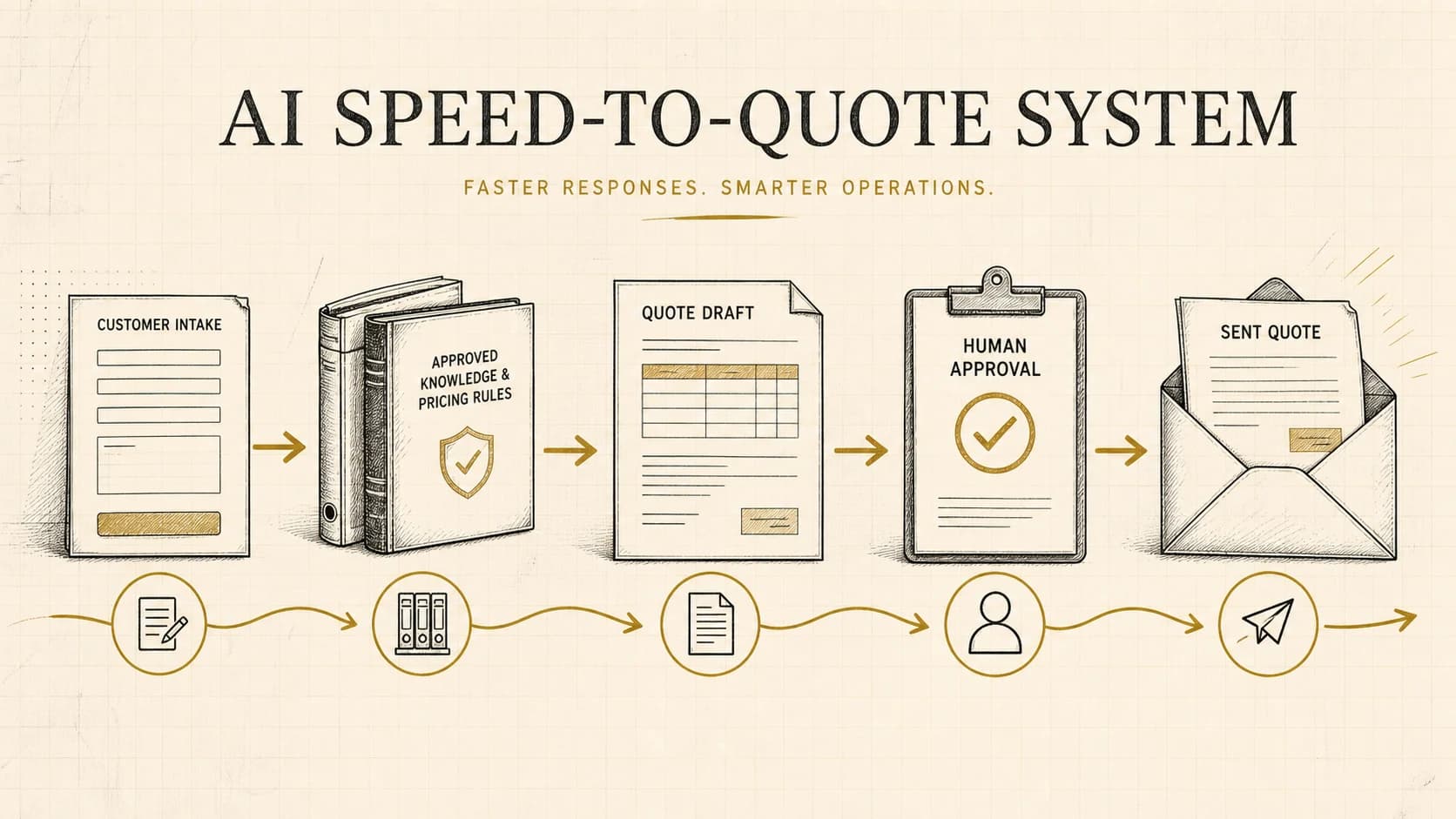
The speed-to-quote guide provides a detailed framework for evidence, rules, approval, delivery, and reconciliation when pricing depends on service inputs.
5. Put review where judgment changes
Not every proposal needs the same approval. A standard offer inside published boundaries may need a lightweight owner check. A custom scope, unusual term, discount, sensitive claim, accelerated date, subcontractor, or material data requirement should trigger the appropriate specialist.
Show reviewers the changes and risks rather than asking them to reread boilerplate. Present source conflicts, nonstandard sections, commercial deviations, missing evidence, and client commitments in one review queue.
Approval must bind to the exact document version. If the system regenerates content after approval, require a new review for the changed sections.
6. Keep the CRM and delivery state coherent
Sending a proposal changes business state. Record the document version, recipients, sender, approved value, service, owner, sent time, expiration or review date, and the next action.
Handle opens and clicks as weak signals, not proof of buyer intent. A reply, requested change, signed document, or explicit decline carries more meaning. Make human notes and client messages part of the same visible conversation history.
When a proposal is accepted, carry the exact approved scope, exclusions, obligations, and stakeholders into onboarding. Do not rebuild the promise from a generic template. The client should never discover that sales and delivery used different versions.
7. Automate follow-up without losing context
Follow-up should answer the current state: Was the proposal delivered? Is a stakeholder missing? Did the prospect ask a question? Is a revision under review? Has the owner already contacted them?
Use a shared state and check it immediately before sending. Suppress automation after a reply, meeting, decline, acceptance, manual takeover, or material proposal change. Replayed events must not create repeated messages.
The lead follow-up system guide explains how to preserve source, conversation, ownership, and next action across channels.
8. Test proposal failure modes
Test a standard engagement, custom scope, missing discovery fact, outdated service block, pricing exception, incorrect entity match, conflicting stakeholder instructions, unavailable delivery capacity, duplicate generation event, manual edit during a run, expired approval, and client revision.
Verify that unsupported claims are absent, totals reconcile, nonstandard terms route correctly, approved content remains unchanged, current state blocks duplicate sends, and acceptance creates the correct downstream record.
Run visual review too. Tables, page breaks, signature blocks, links, attachments, and accessibility can fail even when the underlying fields are correct.
9. Proposal automation checklist
Good proposal automation shortens the distance between understanding a buyer and presenting an offer the firm can deliver. It does not outsource commercial judgment to a document generator.
If proposal work is slow because discovery, scope, knowledge, pricing, and ownership live in separate systems, apply for an assessment to identify the bottleneck and the practical next move before you buy another tool.