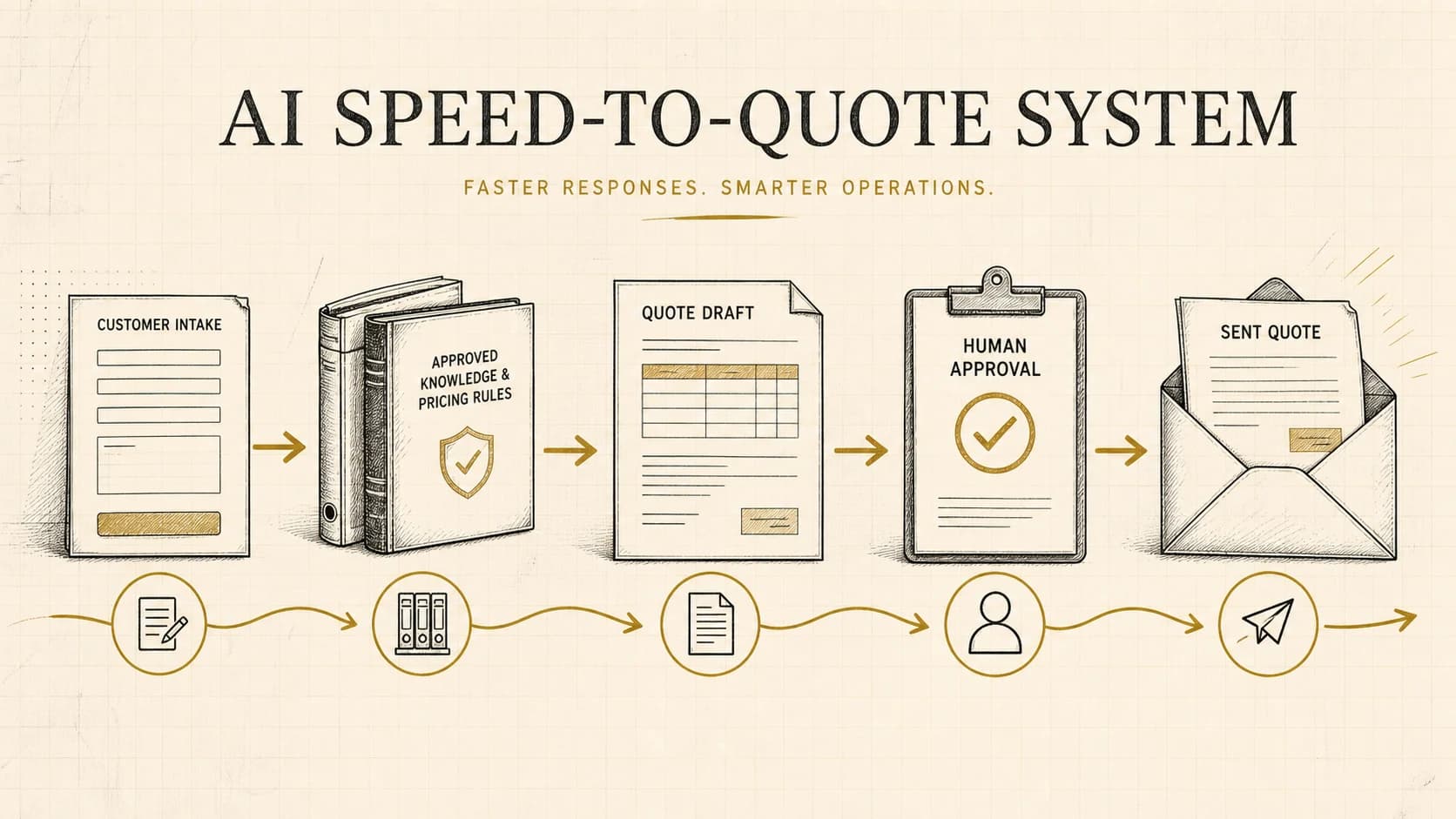
An AI speed-to-quote system prepares a complete, reviewable quote from approved company information. It collects the facts needed to price the work, applies documented rules, drafts the quote, routes exceptions to the right person, and records what happened. It should not invent pricing or quietly turn a draft into a customer commitment.
That distinction matters because quote delay is rarely a document-generation problem. The visible output may be a PDF or email, but the real work happens earlier: clarifying scope, finding the current price rule, checking similar jobs, recognizing an exception, and locating the person allowed to approve it.
If those decisions live across an inbox, a spreadsheet, old proposals, and one experienced employee's memory, adding AI does not remove the uncertainty. It makes the uncertainty move faster. A dependable system starts by making the quoting process and its knowledge explicit.
1. What an AI speed-to-quote system does
Speed to Quote is best understood as a controlled preparation function. It turns a qualified request into an approval-ready quote package.
The function may:
- gather required customer, site, product, and service details;
- identify missing information before pricing begins;
- retrieve current price rules and approved scope language;
- find relevant historical quotes as context;
- calculate or assemble a draft using documented logic;
- explain which sources and assumptions shaped the draft;
- route exceptions or high-value work to a named reviewer;
- create the approved CRM, proposal, and follow-up records.
The function should not automatically inherit every action the existing process contains. Sending the quote, changing a discount, promising a date, or modifying the customer record may require separate approval.
Corey Ganim's Build With AI episode about revenue workflows contrasts visible front-end improvements with operating workflows that connect inquiry, quote, and follow-up. The useful buyer lesson is not that every company needs the same automation. It is that a workflow should reach a meaningful business handoff and have an accountable owner.
Return My Time does not currently have a measured Speed to Quote client engagement. This article describes the operating requirements a buyer should expect, not a promise about turnaround time, revenue, or conversion.
2. Start with a complete intake
A fast draft built from incomplete input only creates a faster revision cycle. Define the minimum information required before the system may prepare a quote.
For a professional service, that might include the requested outcome, deliverables, locations, timeline, stakeholders, constraints, and known exclusions. For a field-service business, it might include property type, measurements, equipment, access conditions, photos, service area, and scheduling requirements.
Separate intake fields into three groups:
| Input class | Purpose | System behavior when missing |
|---|---|---|
| Required | Necessary to determine scope or price | Pause and request the information |
| Conditional | Required only for a defined service, risk, or exception | Ask when the triggering condition is present |
| Helpful | Improves context but does not block preparation | Continue and label the omission |
The intake contract also needs source and ownership rules. A website form may start the process, but an existing account record, signed agreement, or site inspection may override what the requester entered. Define which source wins before two records disagree.
The system should normalize obvious variations without erasing the original input. It can format phone numbers, map a service name to the approved catalog, or identify a likely duplicate. It should preserve the submitted facts and surface uncertain matches rather than silently treating them as confirmed.
3. Give the system approved pricing knowledge
Quote preparation requires company-specific knowledge. A generic model does not know which price book is current, when travel applies, which services may be bundled, who can approve a discount, or which customer has contract pricing.
The pricing layer should identify:
- the current price source and its owner;
- effective dates and superseded versions;
- scope-to-price rules;
- approved units, rates, minimums, and add-ons;
- customer or contract exceptions;
- tax, travel, rush, and payment-term rules;
- discount and approval thresholds;
- standard inclusions, exclusions, and assumptions.
Historical quotes can provide useful context, but they are not automatically policy. An old proposal may contain a one-time exception, an obsolete rate, or a mistake. Label historical material by date, result, service type, and authority. Use it to compare and explain—not to overrule current policy.
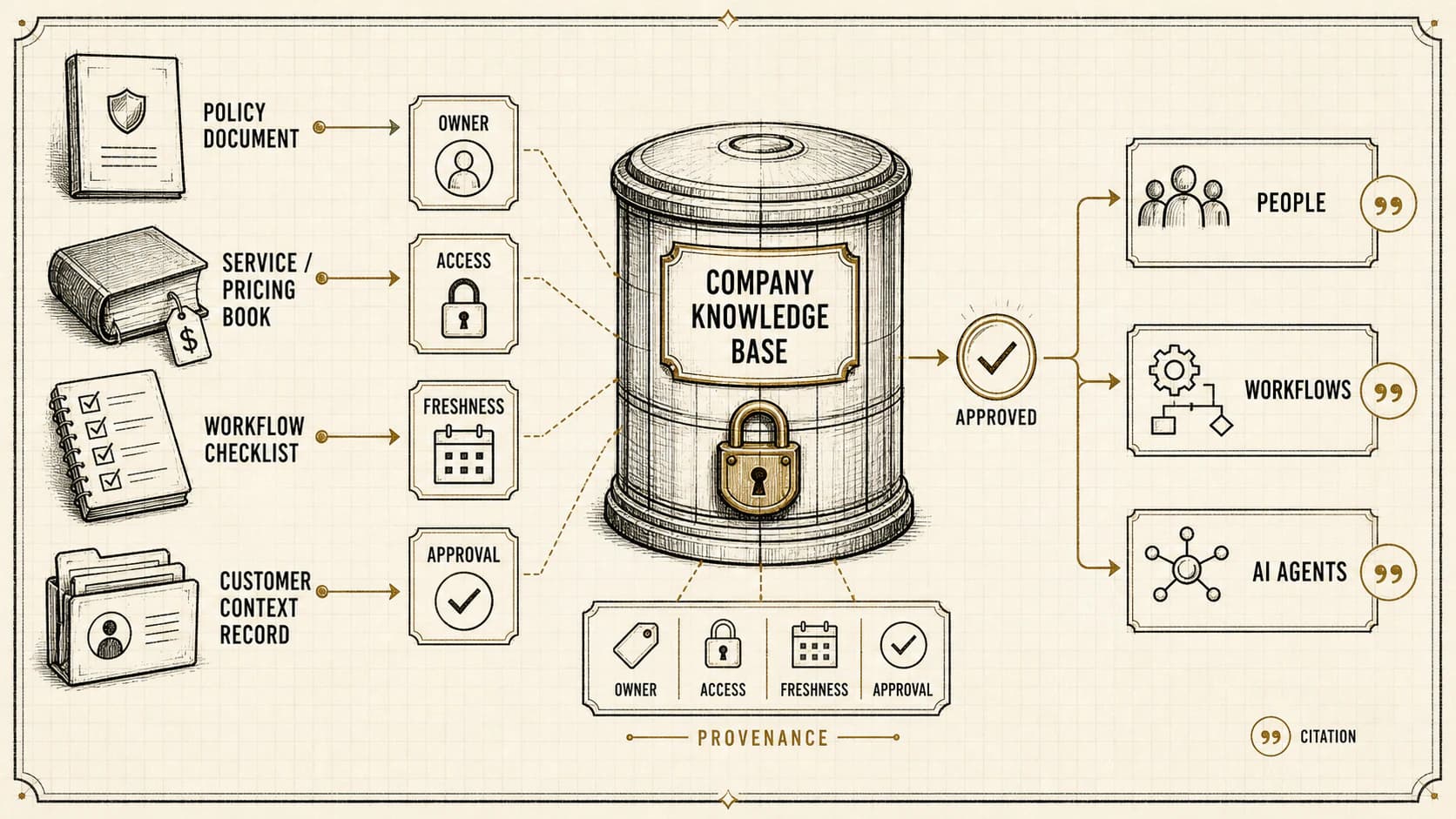
The company knowledge-base guide explains how to distinguish authoritative sources from examples and working material. That hierarchy is essential in quoting. A signed customer agreement may outrank the general price book for one account. The current price book should outrank an old won quote for everyone else.
Every retrieved rule should be traceable. A reviewer should be able to answer, “Why did the draft use this rate?” without reverse-engineering a model's response.
4. Separate quote preparation from quote approval
Preparing a draft and committing the company are different authorities.
A useful approval packet contains:
- the customer's request and normalized scope;
- missing or uncertain inputs;
- the proposed line items and calculations;
- the current sources used;
- historical comparisons, clearly labeled as context;
- assumptions and exclusions;
- requested exceptions;
- the next action the reviewer is approving.
Approval rules should reflect consequence, not enthusiasm for automation. A standard renewal using current contract terms may need a lighter review than a new service, unusual scope, nonstandard discount, or accelerated delivery promise.
Define a named owner and backup for each approval path. “Send to sales” is not operational. The workflow needs a role, queue, response expectation, escalation route, and safe behavior when nobody responds.
The safest default is no external commitment without the required approval. Draft mode lets the team test completeness, accuracy, and reviewer usability before granting any sending authority.
5. Define exceptions before automating the normal path
The quality of the system is often revealed by what it refuses to do.
Common quote exceptions include:
- a required input is missing or contradictory;
- the requested service is outside the catalog or service area;
- the customer has overlapping records or agreements;
- the price source is stale or unavailable;
- the work requires an unfamiliar subcontractor or material;
- the requested discount exceeds authority;
- delivery timing depends on unavailable capacity;
- the request contains a legal, safety, or regulatory concern;
- the draft differs materially from comparable approved work.
For each exception, specify whether the system should ask the customer, create an internal task, route to an estimator, or stop. Also specify the evidence included in the handoff.
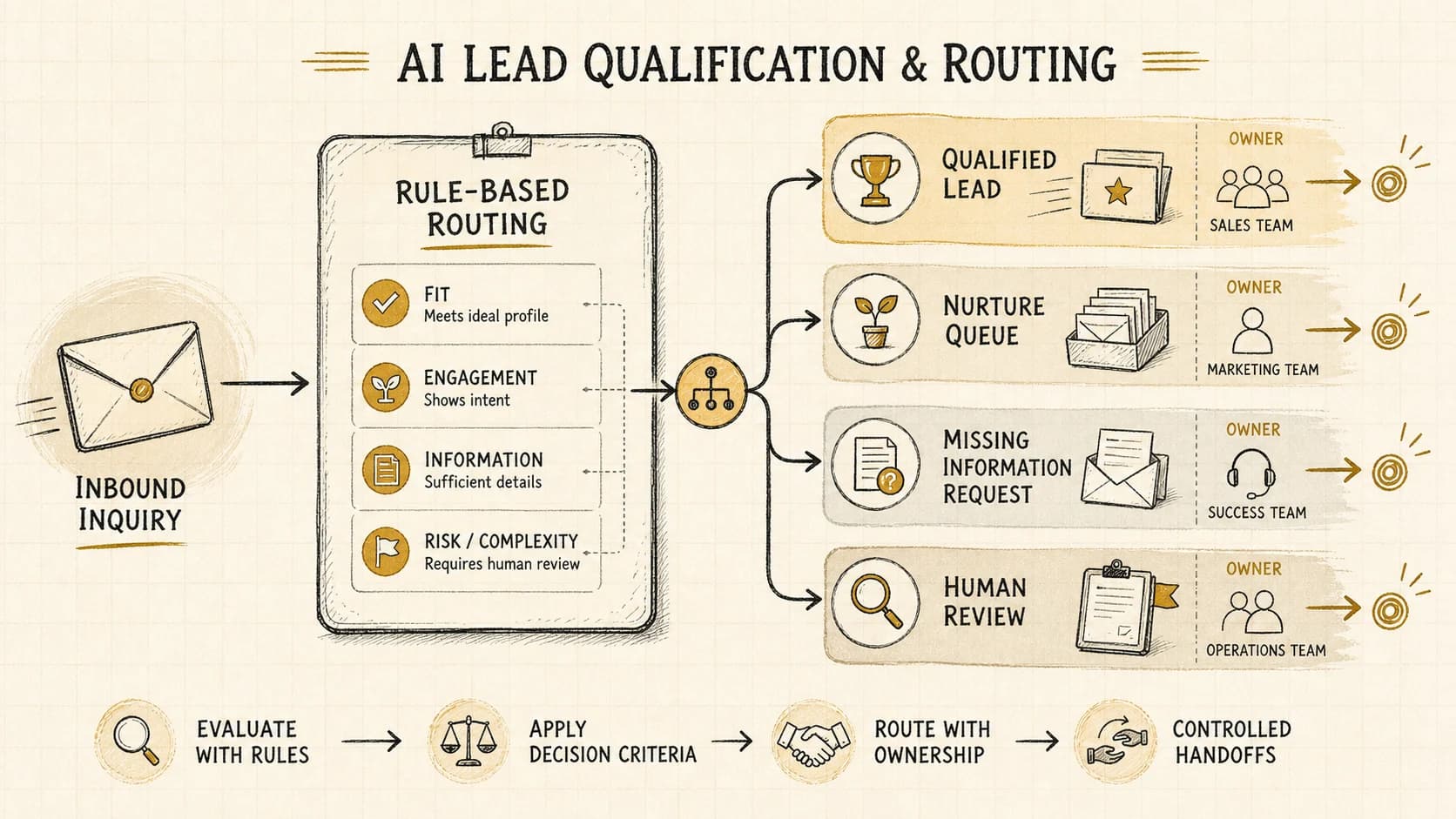
Avoid a single “needs review” bucket. A missing measurement belongs with the intake owner. A contract interpretation belongs with the account or legal owner. An unusual technical scope belongs with delivery. Routing everything to one senior person recreates the original bottleneck.
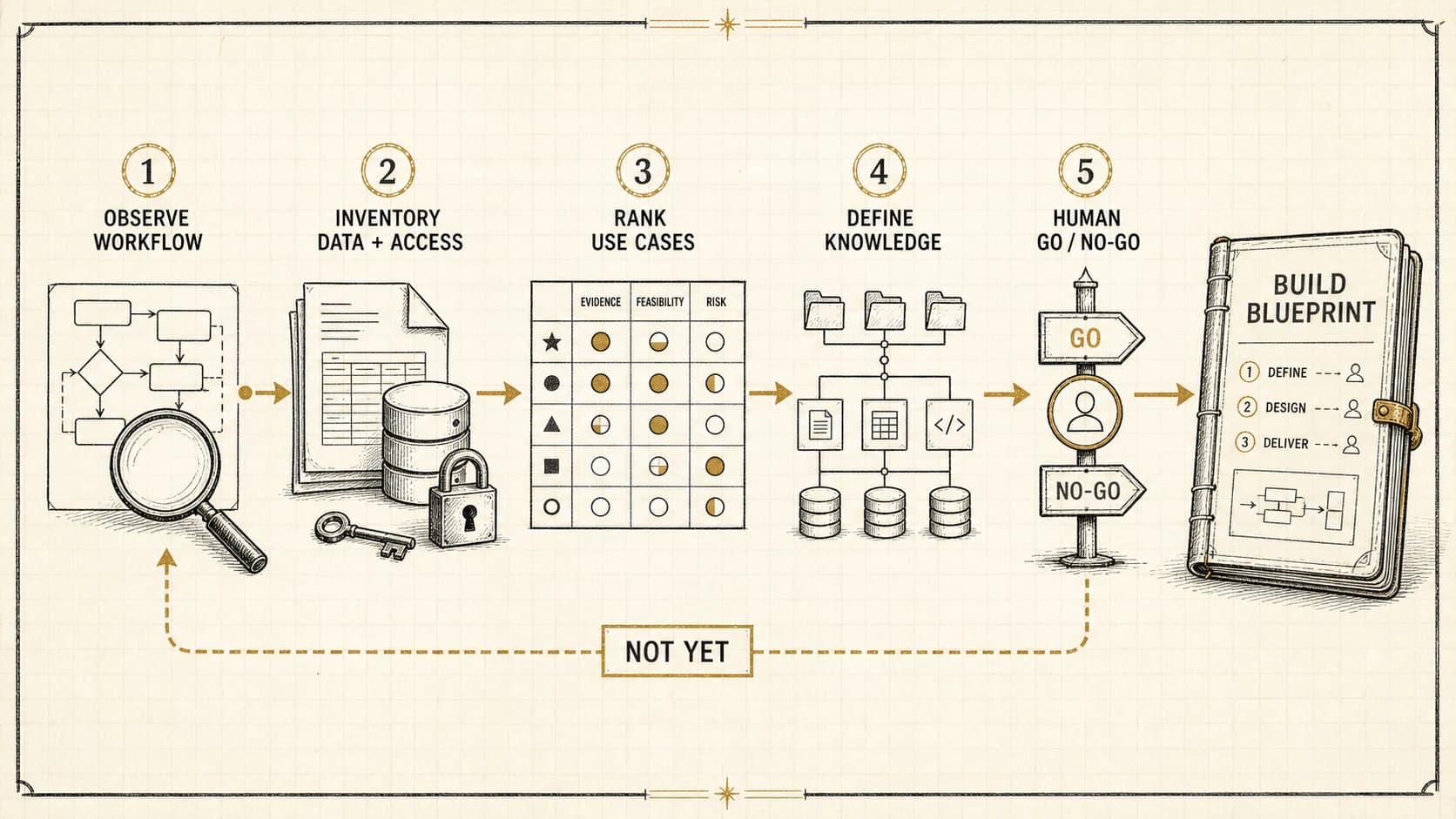
The AI assessment guide can help map these decisions before implementation. If the team cannot explain the exception path on paper, an automated version will not be easier to operate.
6. Deliver, record, and reconcile the quote
Approval is not the end of the workflow. The system needs a clear completion definition.
Depending on the business, completion may require:
- generating the approved proposal or quote;
- sending it through the approved channel;
- recording the final version and approver;
- updating the CRM stage and next action;
- scheduling follow-up;
- confirming delivery or surfacing a delivery failure;
- linking later revisions to the original quote.
Make repeated execution safe. A retry after a tool failure should not create duplicate opportunities, send two proposals, or overwrite a later human edit. Use stable record identifiers, idempotent actions where possible, and explicit version history.
Reconciliation catches the gap between “the automation ran” and “the business record is correct.” A daily or event-driven check can compare prepared quotes, approvals, sent messages, CRM status, and unresolved exceptions. Any mismatch should become visible work with an owner.
7. Measure the workflow without inventing ROI
Measure the system against its function and baseline. Do not begin with a borrowed industry statistic or an assumed conversion lift.
Useful operating measures include:
| Measure | Question it answers |
|---|---|
| Intake completeness | How often can preparation begin without another request? |
| Time awaiting information | Is delay caused by the system or missing customer/team input? |
| Draft preparation time | How long does controlled preparation take? |
| Approval wait time | Where does human review become the bottleneck? |
| Exception rate by reason | Which rules or intake fields need improvement? |
| Revision rate | How often does the approved draft require material correction? |
| Record reconciliation failures | Did the proposal, message, and CRM state stay aligned? |
Business outcomes can be measured later against the company's own baseline. Quote acceptance, follow-up completion, margin, and sales-cycle movement may matter, but they are influenced by price, demand, capacity, positioning, and sales behavior—not only preparation speed.
8. Speed-to-quote readiness checklist
A speed-to-quote system is ready to build when the team can describe how a request becomes an approved commitment and can show where every important rule comes from. If that map is incomplete, begin with assessment and knowledge work rather than automating around the gaps.
If slow or inconsistent quoting is an owner-felt problem, apply for an assessment. We’ll examine the repeated work, estimate the time cost, and recommend the most practical first move.