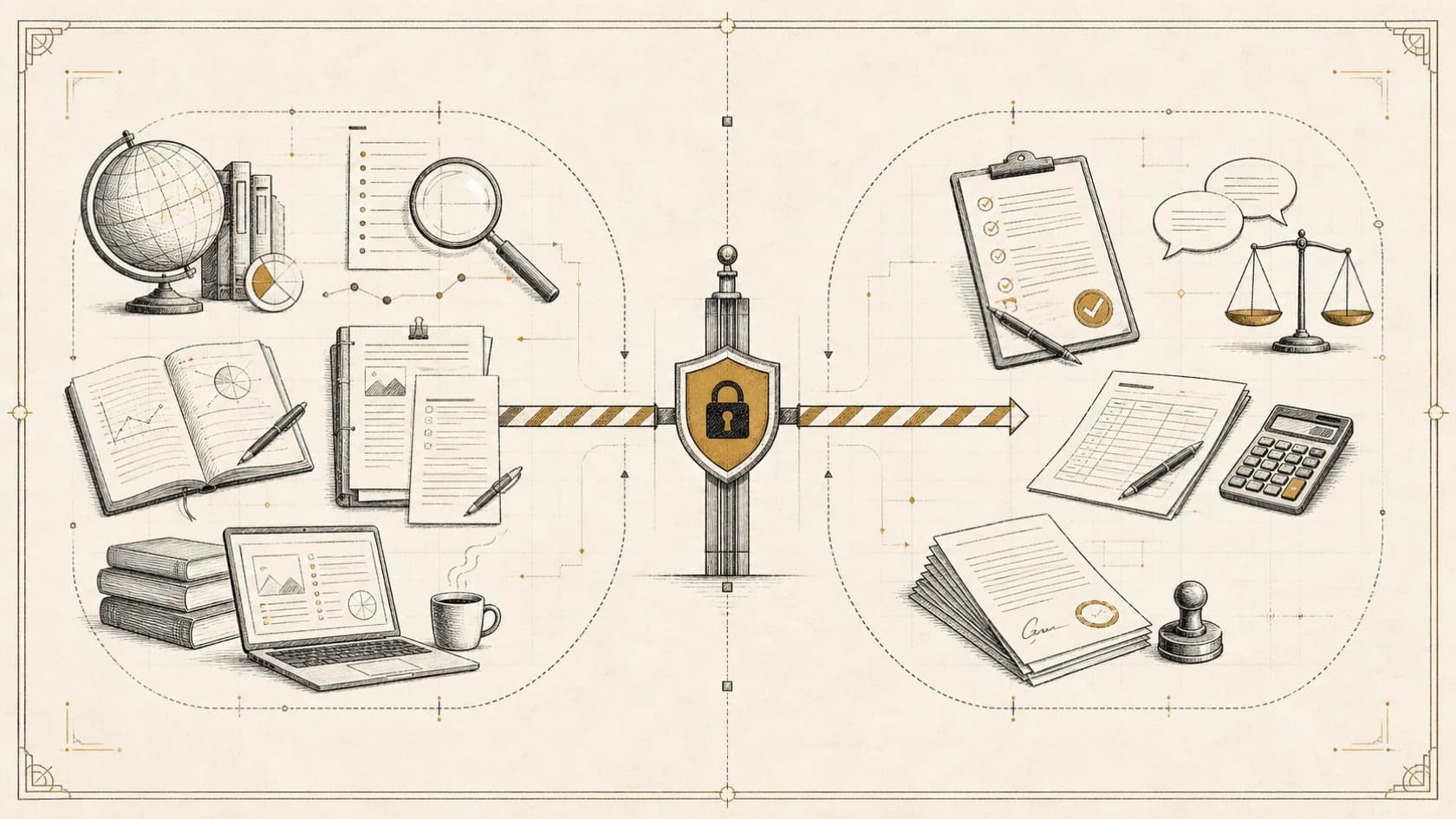
An AI sales assistant should reduce the work required to prepare, document, and follow through on sales conversations. It should not become an unaccountable substitute for the judgment behind qualification, positioning, scope, price, negotiation, or customer commitments.
The most useful delegation line is not “AI versus human.” It is bounded, reviewable work versus consequential decisions that require authority and context.
1. Inventory the work around the conversation
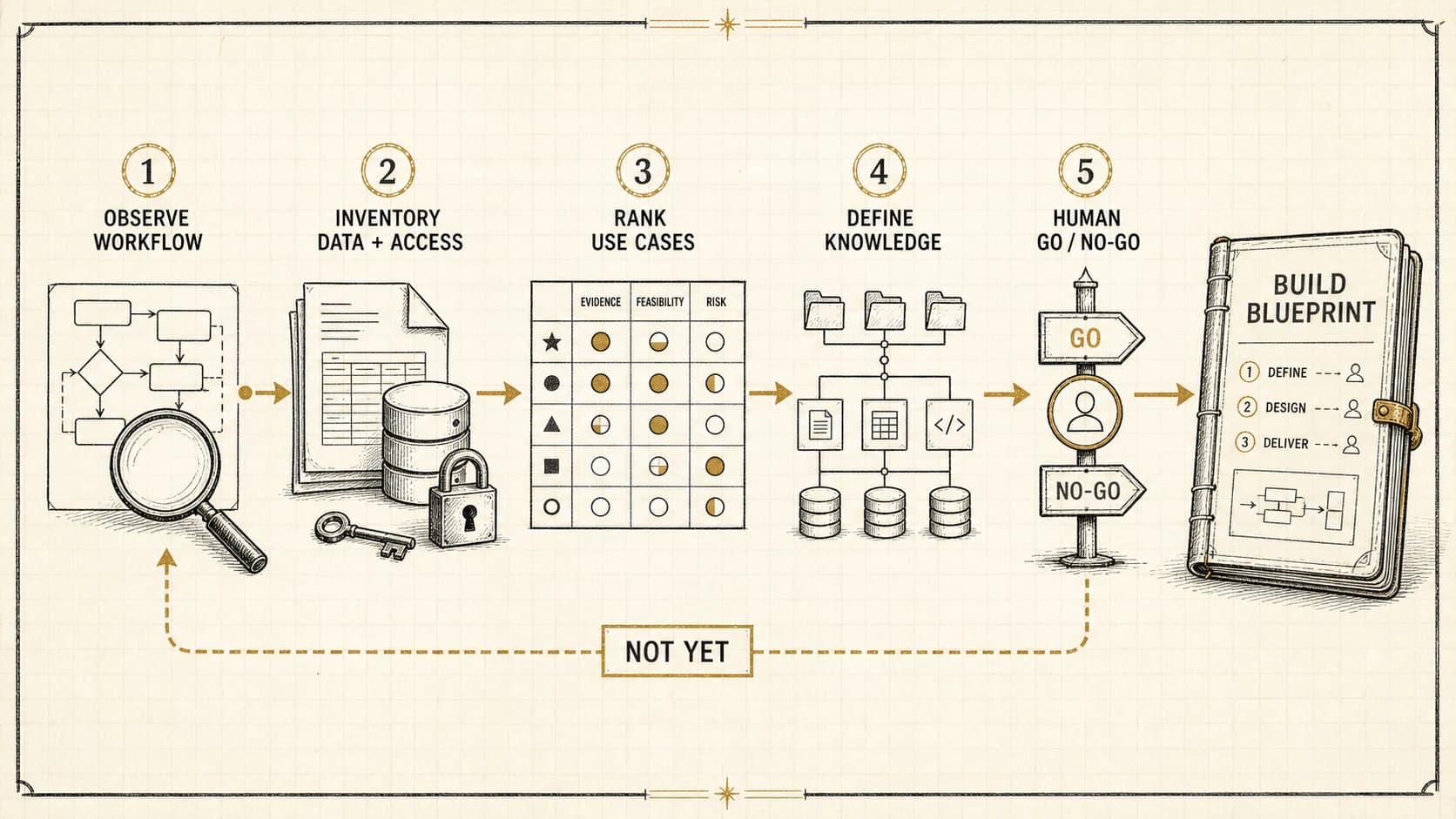
Observe the full sales workflow. The visible meeting is surrounded by research, intake, routing, preparation, note capture, record updates, follow-up, internal coordination, proposal inputs, and pipeline review.
Classify tasks by consequence and clarity:
| Work | Good starting mode | Human boundary |
|---|---|---|
| Assemble account context from approved systems | Automated retrieval and cited summary | Human resolves conflicting identity or sources |
| Prepare discovery questions from known gaps | Draft for representative review | Human chooses what is appropriate in the conversation |
| Summarize a meeting | Draft linked to transcript or notes | Human corrects commitments and sensitive nuance |
| Update routine CRM fields | Recommend, then narrow write permission | Human approves ownership, stage, value, and exceptions |
| Draft follow-up | Draft from approved facts and pattern | Human approves promises, scope, pricing, and sensitive language |
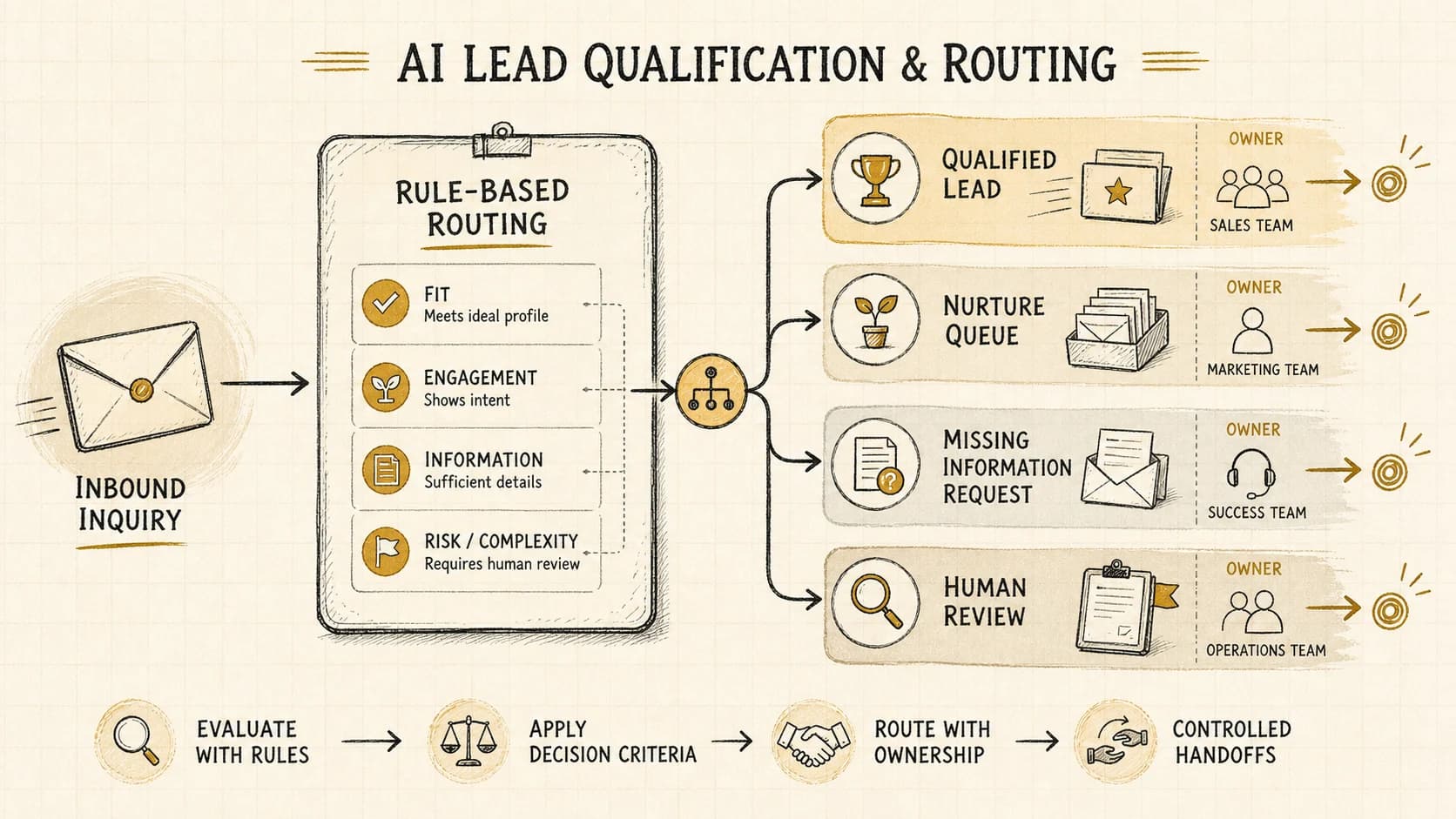
| Qualify or route | Apply published rules with evidence | Human reviews ambiguity and exceptions |
| Negotiate or commit | Human action | AI may prepare context, never grant itself authority |
This map should reflect the company’s real risk, not a generic list of AI features.
2. Start with preparation and documentation
Preparation is often a strong first use because the assistant can gather information without contacting the prospect or changing a system of record.
Define approved sources: CRM, submitted form, prior correspondence, service catalog, account notes, and selected public sources. Require the output to distinguish sourced facts, missing information, and inference. A polished paragraph without provenance is difficult to trust.
For meeting documentation, preserve access to the source record. Summaries should identify decisions, customer language, objections, commitments, questions, owners, and due actions. A person should confirm anything that changes commercial state.
3. Keep business policy outside the model
Qualification criteria, stage definitions, service fit, pricing rules, approval thresholds, legal language, and offer details need authoritative, versioned sources.
The model may apply or retrieve those rules. It should not infer policy from a handful of old deals or imitate the most common behavior in the CRM. Historical data can contain exceptions, mistakes, and outdated strategy.
The company knowledge base guide explains how to create a source of truth with ownership and citations. Without that foundation, a sales assistant will produce fluent inconsistency.
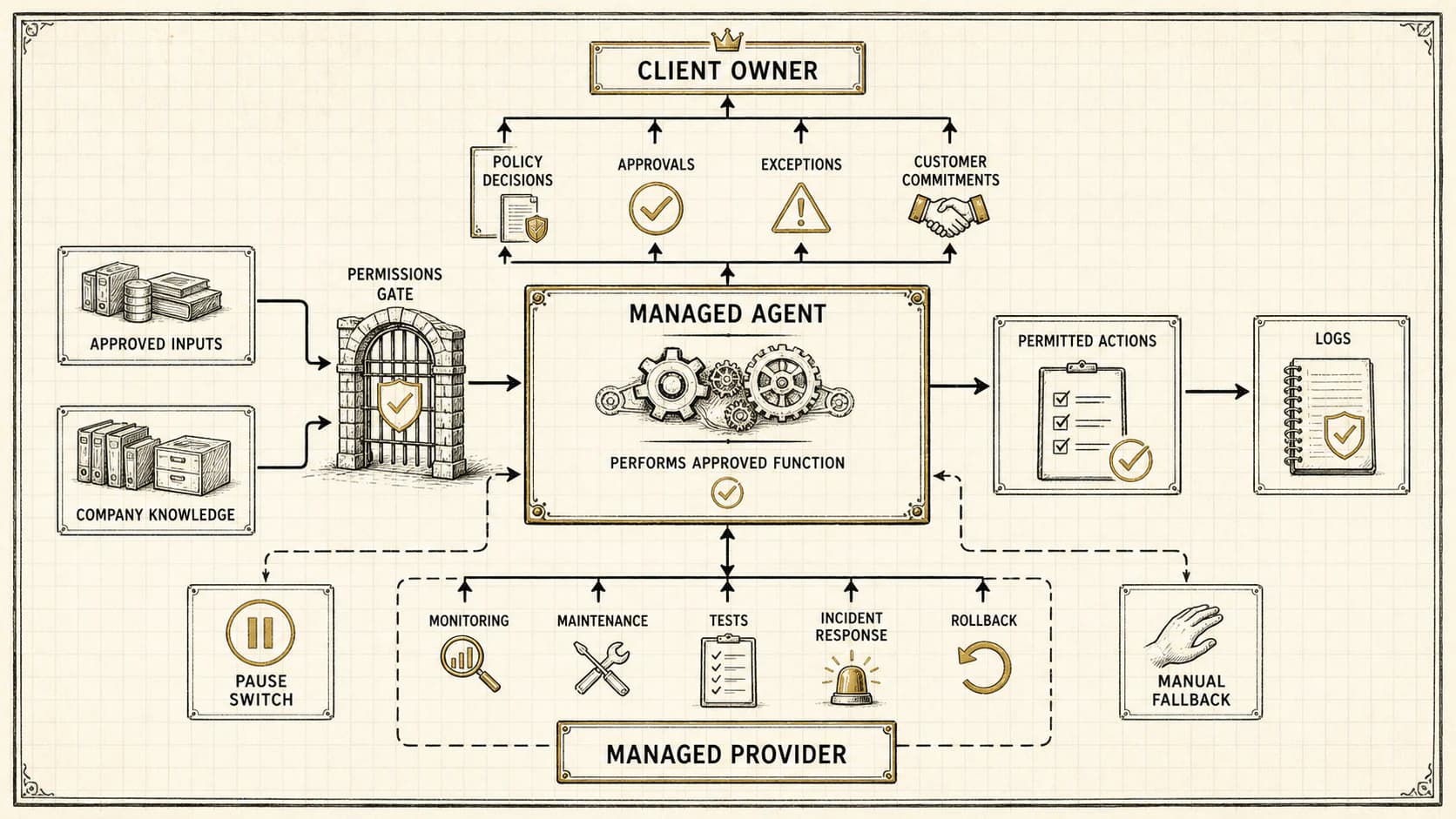
4. Design CRM access as a permission ladder
Begin read-only. Then allow recommendations. Add narrow writes only after acceptance tests prove the specific operation.
A safe sequence might be:
- read approved lead and account fields;
- draft a meeting brief;
- recommend missing fields and next actions;
- write low-consequence notes with attribution;
- create approved tasks;
- update selected fields under deterministic rules;
- keep ownership, stage, forecast, value, merge, and deletion behind approval.
Use stable identifiers and conflict checks. If a representative changes a record after the assistant reads it, the assistant should not overwrite the newer decision. Retries must not duplicate notes or tasks.
5. Control external communication
Drafting and sending are different authorities. Start with drafts that show the facts and template used.
Before an external message can send, verify recipient, relationship, current stage, consent, conversation history, promises already made, approved content, and stop conditions. Re-check immediately before execution because a reply or manual action may change the state.
Keep negotiation, pricing, scope, legal terms, complaints, and exceptions human. Even a routine follow-up should pause when the source record conflicts or the customer asks something outside the approved knowledge.
6. Make uncertainty operational
“Low confidence” is not a workflow. Define what the assistant does when required data is missing, sources disagree, identity is ambiguous, policy has no applicable rule, or an integration fails.
The safe behavior may be to request a specific missing fact, draft a clarification, create a review task, or stop and show the evidence. Route to a named role with an expected response path. Do not send every uncertainty to a generic inbox.
Overrides are useful evidence. Review whether the assistant missed a source, applied an unclear rule, or encountered a legitimate exception. Update the knowledge, policy, test set, or permission accordingly.
7. Evaluate impact without inventing attribution
Establish a baseline before rollout. Measure preparation time, records missing required fields, unowned next actions, overdue internal work, representative corrections, draft acceptance, failed writes, and unresolved exceptions.
Revenue outcomes depend on lead quality, offer, salesperson skill, market, delivery confidence, and many other factors. Treat an operational improvement as operational evidence. Do not claim the assistant caused revenue growth unless the measurement design supports that conclusion.
The AI assessment guide shows how to select a workflow from evidence instead of buying an assistant and searching for work afterward.
8. Build an acceptance set from real sales variation
Use sanitized examples for clear fits, disqualifiers, incomplete records, duplicate accounts, current customers, referrals, policy exceptions, price questions, complaints, multiple stakeholders, conflicting notes, system outages, and manual changes during execution.
For each example, specify the allowed sources, expected output, forbidden actions, approval point, and final system state. Review both factual accuracy and commercial appropriateness.
9. AI sales assistant checklist
An AI sales assistant is a managed role, not a chat window with CRM access. If your team spends substantial time rebuilding context, updating records, and coordinating follow-through, apply for an assessment. We’ll review the repeated work, its time cost, and the practical opportunity worth doing first, then deliver a decision-ready personalized report.