AI automation services are justified when a valuable process requires language understanding, retrieval from business knowledge, several system actions, managed exceptions, and ongoing operational care. Many tasks do not need that complexity.
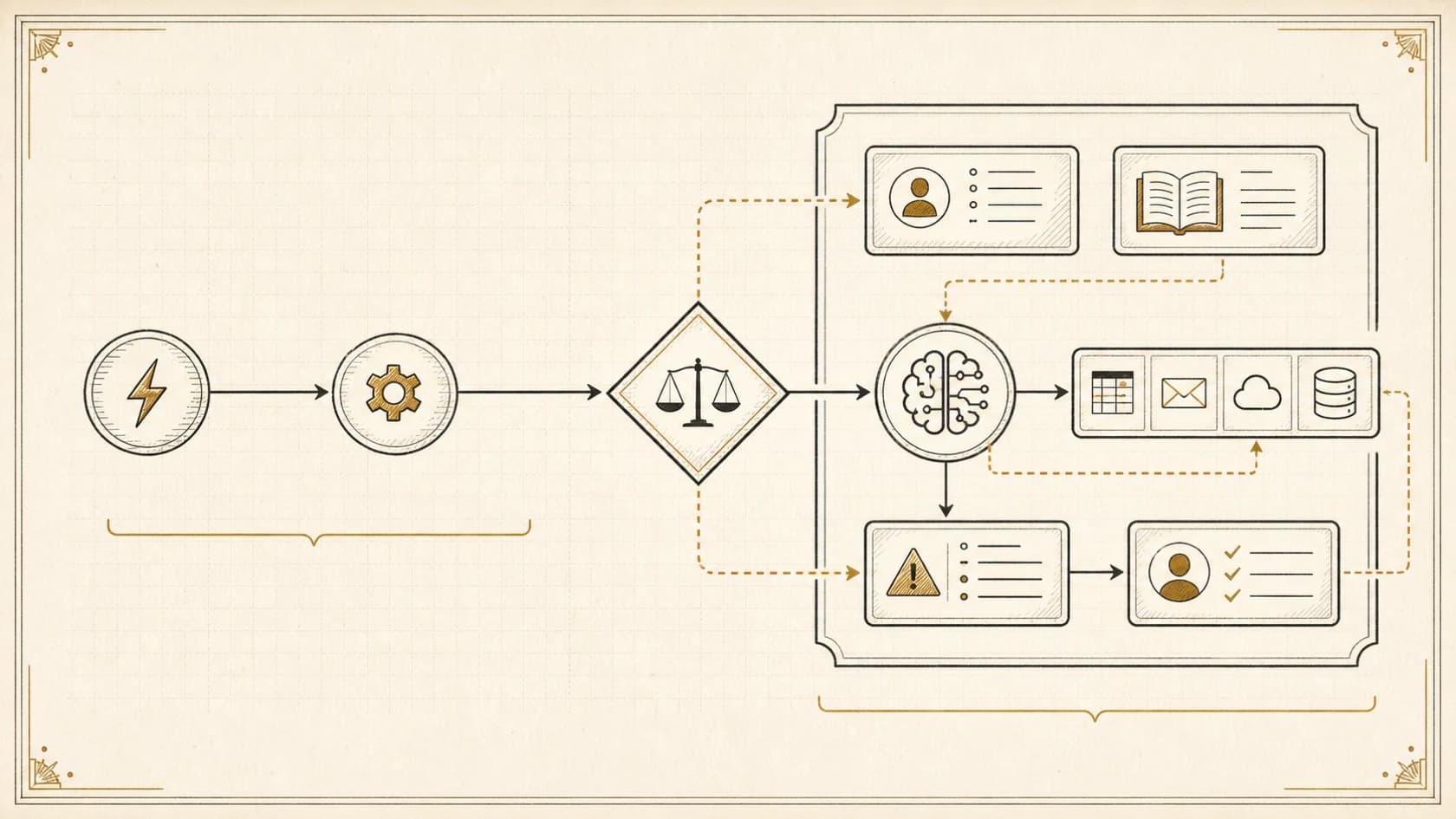
If a deterministic trigger and action can solve the problem reliably, use it. If the process changes with context and consequence, another isolated workflow may hide the real operating need.
1. Start with the simplest reliable mechanism
Describe the process without naming tools. Identify trigger, required inputs, decision, action, exception, owner, and completion evidence.
| Process characteristic | Likely starting point | Why |
|---|---|---|
| Stable structured trigger and action | Simple rule-based automation | Easy to inspect and test |
| Language extraction with a fixed downstream rule | AI-assisted step inside deterministic workflow | Model handles language; code controls policy |
| Several sources and context-dependent recommendations | Knowledge-backed assistant with review | Evidence and human judgment remain visible |
| Multi-step action across systems with bounded authority | Managed agent | Requires state, tools, permissions, and reconciliation |
| High-consequence ambiguity or policy exception | Human-led process with AI preparation | Authority and accountability stay human |
The small-business Zapier guide gives examples of useful simple automations and the point where complexity starts to outgrow them.
2. Look for variation that rules cannot express cleanly
AI may help when requests arrive in natural language, terminology varies, documents need interpretation, or relevant facts must be retrieved from several approved sources.
Variation alone does not mean the entire process should be agentic. Use the model for the language-dependent step and deterministic controls for identity, calculations, permissions, deadlines, and policy.
If operators cannot explain how they make the decision, pause. The first work may be documenting policy or aligning the team, not automating judgment.
3. Count exceptions and handoffs
Simple workflows work best when exceptions are rare and safe to place in a visible queue. They break down when exceptions require context from several systems, different owners, customer communication, and reconciliation.
Map missing information, duplicates, conflicts, outages, unavailable owners, policy exceptions, and manual changes. Define the safe state and resolution path for each. A managed service is valuable when it owns this operating layer, not merely the happy path.
4. Evaluate consequence and authority
Ask what can happen if the automation is wrong. Moving an internal notification has a different consequence from changing an account, quoting a price, sending a customer message, or scheduling scarce capacity.
Choose an authority level for every action: recommend, draft, require approval, or execute. Expand authority only after the narrower mode passes representative tests.
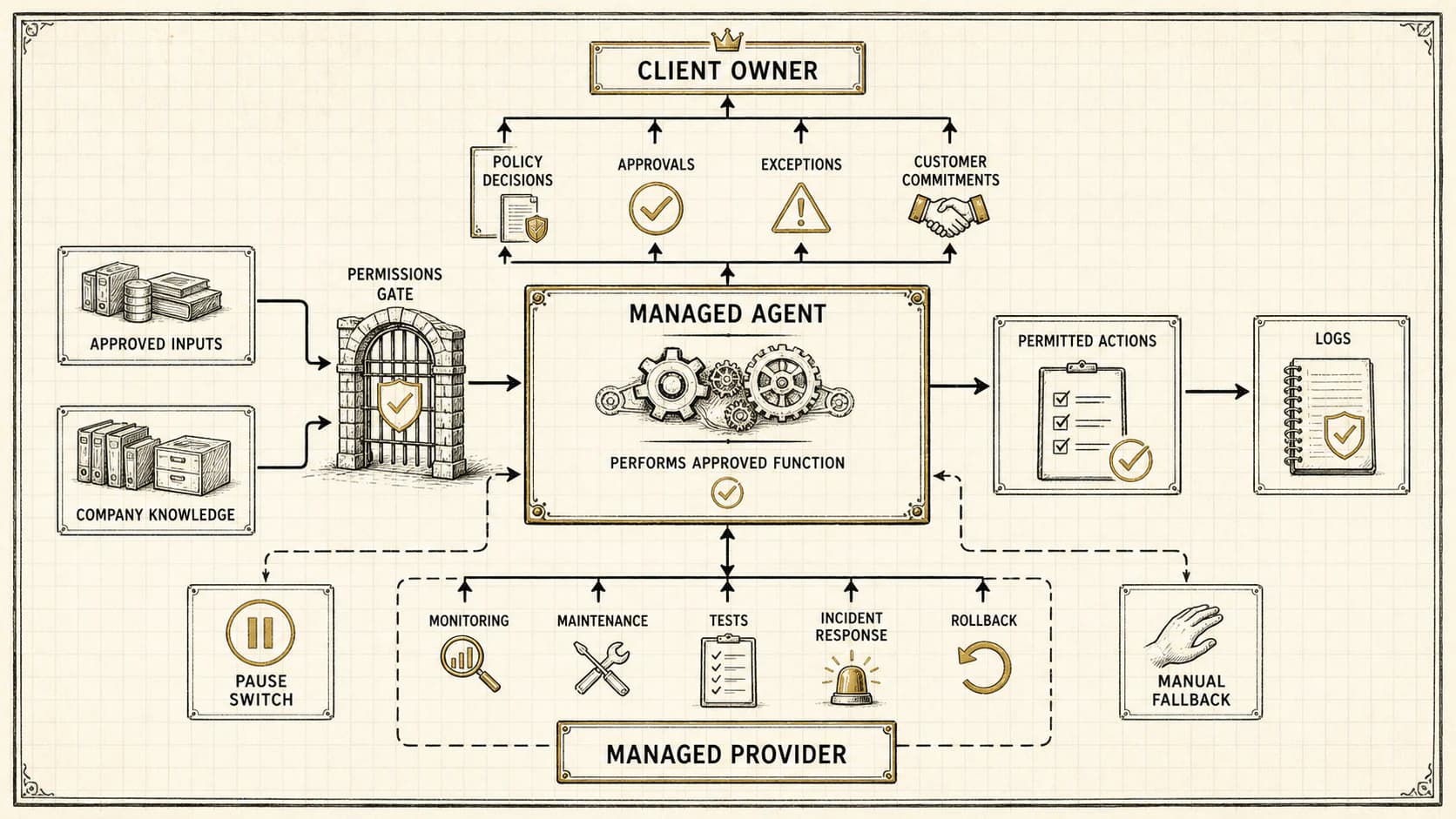
The managed-agent ownership guide explains permissions, approvals, credentials, and accountability. A managed system should make these controls more visible, not less.
5. Inspect the knowledge requirement
If the workflow depends on current services, policies, customer history, or operating procedures, it needs governed knowledge. A model’s general training is not company policy.
List sources and assign authority, owner, effective date, and update path. Require citations for retrieved facts and a safe response when the answer is unsupported. The knowledge-base guide covers this foundation.
Knowledge maintenance is one reason a managed service may be appropriate. The agent’s answer quality will drift if the business changes and no one owns the source.
6. Compare total operating cost
Simple automation has build and maintenance costs. A managed AI system adds model use, evaluation, monitoring, incident response, knowledge upkeep, and more complex integration testing. It may still be worthwhile for a material process, but compare the full operating model.
Estimate current manual effort, delay, error recovery, and business impact. Show assumptions. Include human review and exception handling in the future state. Measure a bounded pilot against the baseline rather than treating a projected saving as a result.
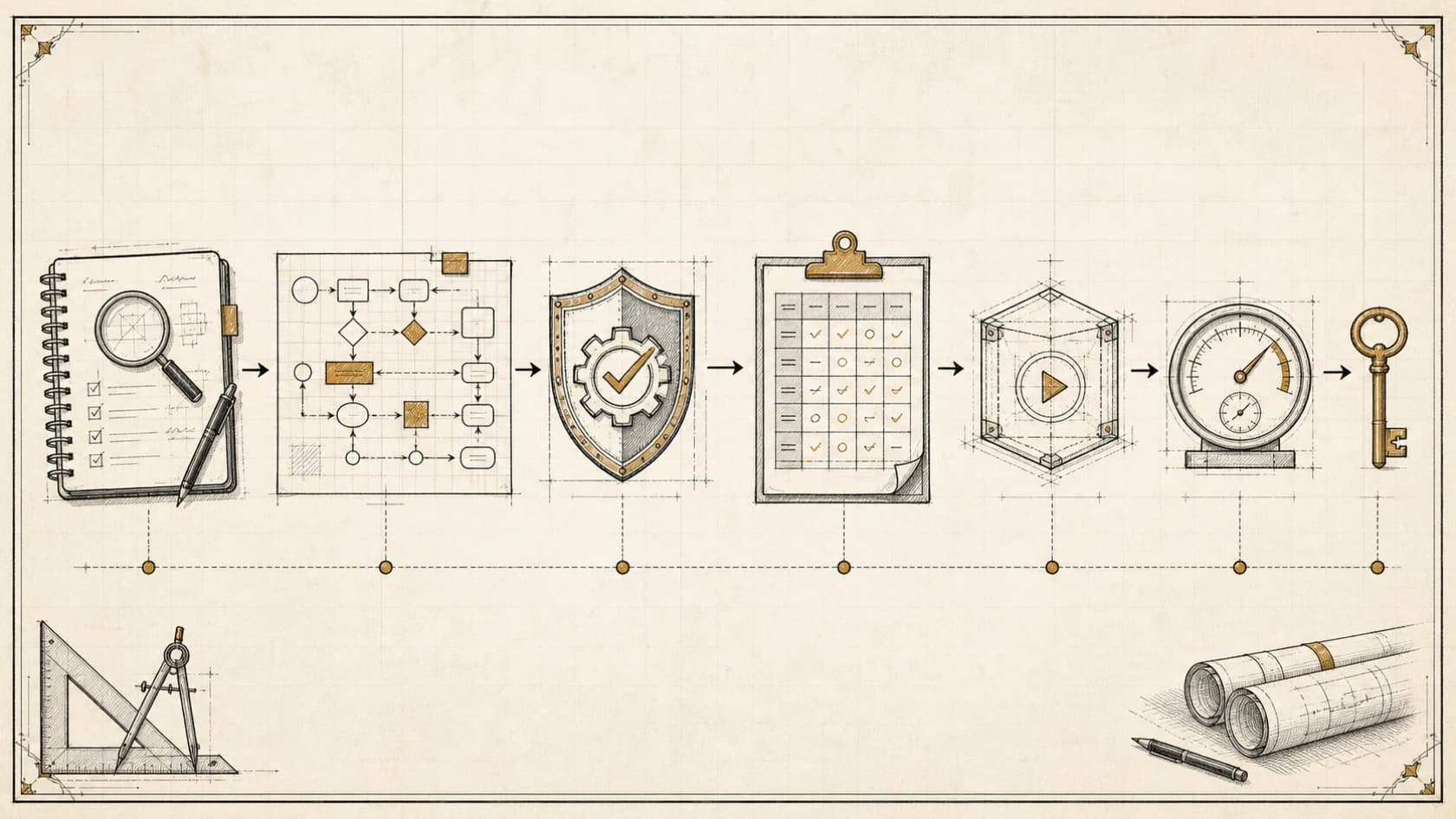
7. Require tests that match the chosen complexity
For a deterministic workflow, test every branch, duplicate event, failure, retry, and final state. For an AI-assisted workflow, add representative language variation, missing evidence, conflicting sources, uncertainty, and prohibited actions.
For a managed agent, test multi-step state, permission boundaries, tool failures, stale records, human changes during execution, handoff completeness, and rollback. Keep regression cases for every discovered failure.
Corey’s three-level automation framework offers a useful way to think about increasing capability. The right level is the lowest one that reliably handles the business requirement.
8. Ask what the service manages
“Managed” should specify monitoring, knowledge updates, integration changes, model or prompt changes, access review, costs, incidents, response boundaries, reporting, and termination.
Ask who owns each responsibility and what evidence you receive. Uptime alone is insufficient; the system can be available while making the wrong decisions or leaving exceptions unresolved.
Specify the service boundary during normal operation and incidents. The provider should say which alerts it receives, which issues it resolves without client approval, which business decisions return to the client, and how quickly each party must acknowledge an escalation. Define access to logs, source materials, configurations, and change history so the company can understand the system it depends on.
Portability matters too. Ask what happens if a vendor, model, integration, or service relationship changes. The business should retain its knowledge, workflow definitions, evaluation cases, documentation, and appropriate operating records. A managed service should reduce operational burden without making the function impossible to understand or transition.
The business process automation services guide provides a deliverable checklist for comparing providers.
9. AI automation decision checklist
The choice is not “AI or no AI.” It is the right operating design for a specific constraint. If a recurring workflow has outgrown simple triggers because it depends on context, knowledge, and coordinated action, apply for an assessment. Return My Time will identify the opportunity worth doing first and recommend a practical next action.