Business process automation services should deliver a process that operates more reliably, with clearer ownership and less avoidable manual work. The deliverable is not a collection of connectors, prompts, or impressive demos.
A good provider first determines whether the process is worth automating. Then it documents the current state, designs the future state, controls permissions and exceptions, tests the complete path, and leaves the client with an operating model.
1. Expect discovery before tooling
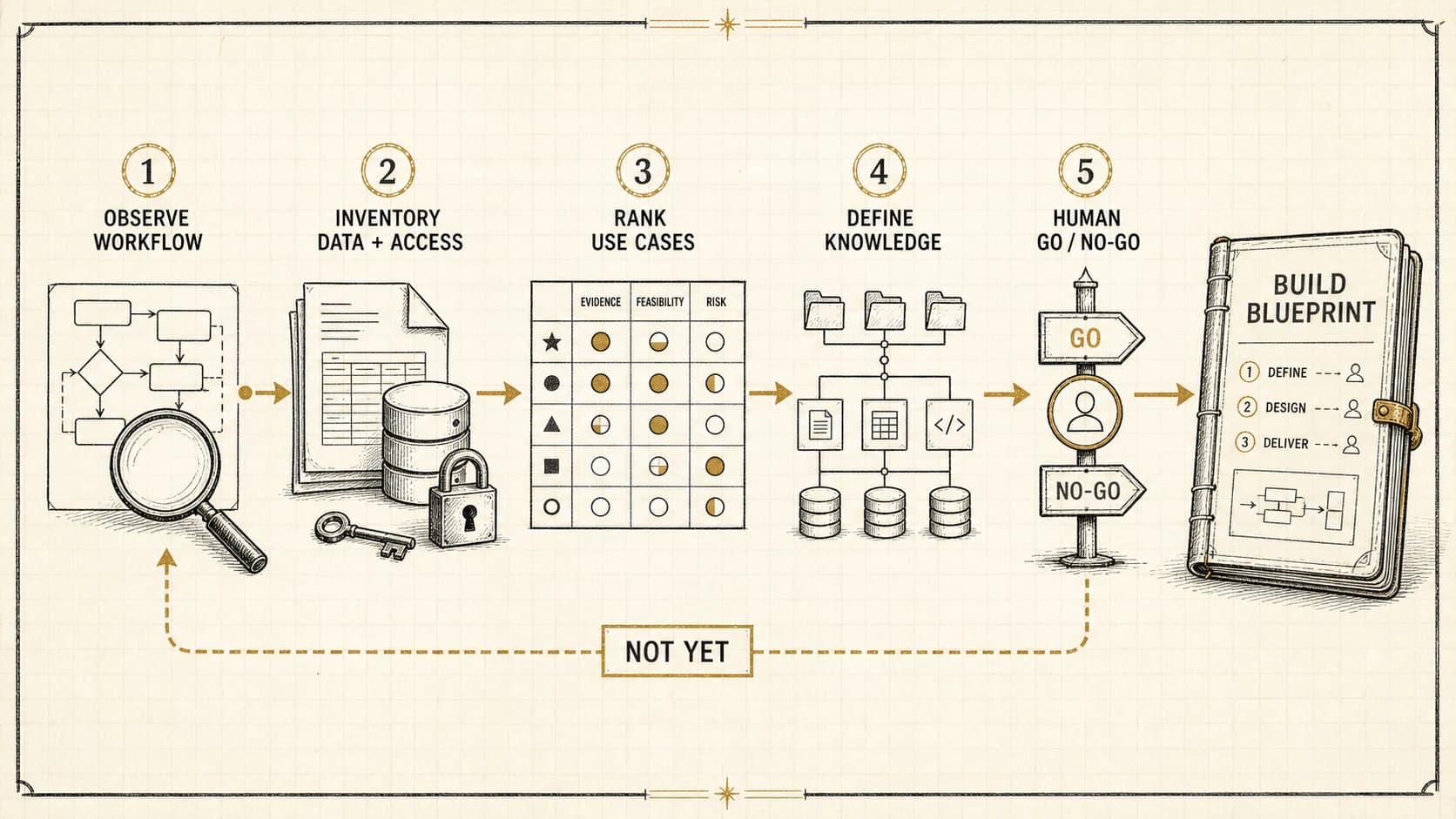
The provider should observe the process using records, system states, handoffs, and representative examples. Interviews help, but people often describe the intended workflow rather than the one that actually happens.
Discovery should establish volume, variation, wait states, rework, exceptions, systems, data quality, owners, customer consequences, and the current baseline. It should identify whether the bottleneck is execution, missing policy, fragmented knowledge, poor intake, unclear ownership, or a system limitation.
The wrong-problem guide explains why visible busywork can be downstream of a different constraint. Automating the symptom can make the wrong process move faster.
2. Require a concrete deliverable set
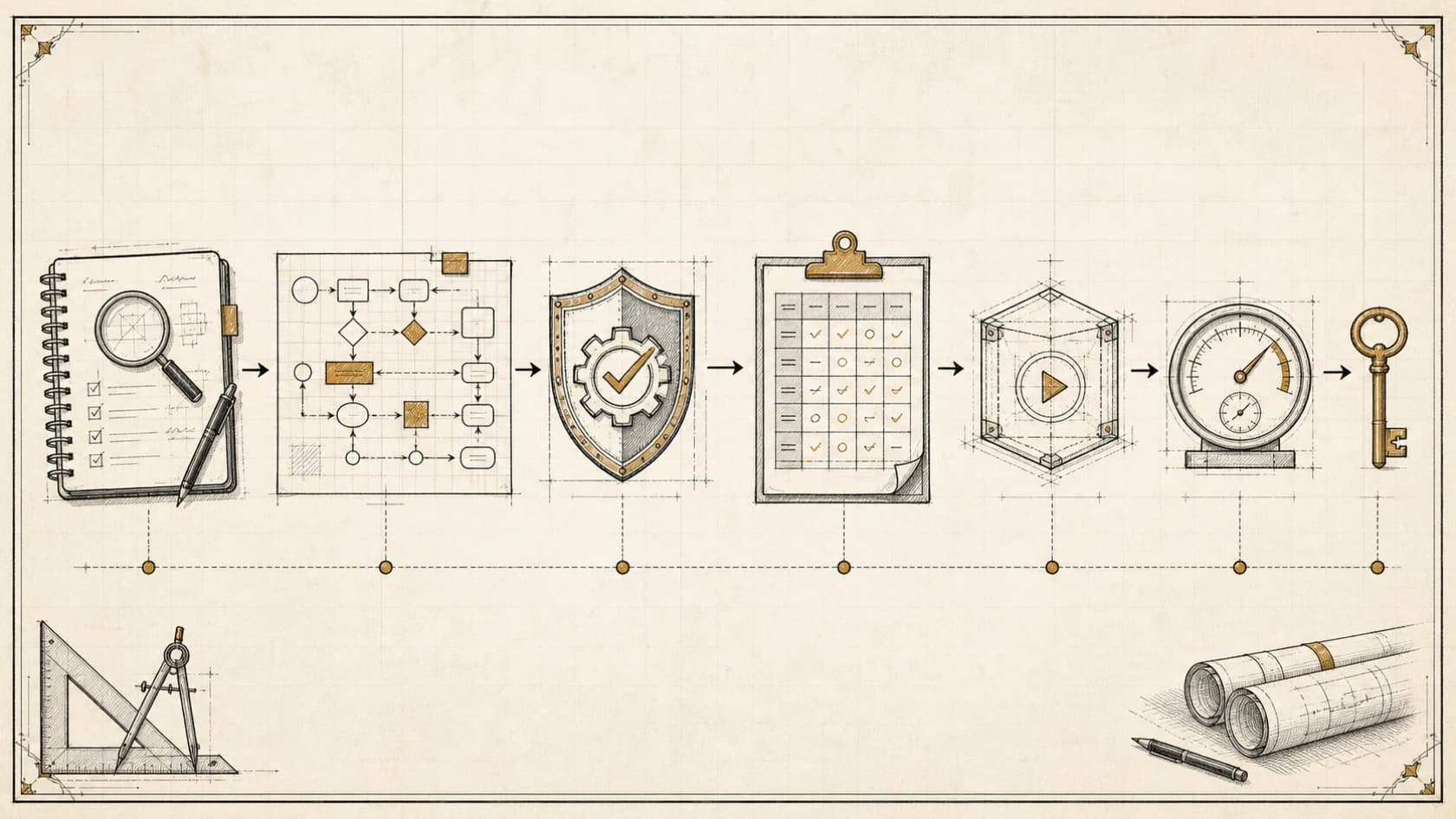
Ask the provider to name what you will receive at each stage.
| Deliverable | What it should answer | Acceptance evidence |
|---|---|---|
| Current-state map | What happens now, including exceptions and systems | Operators recognize the real workflow |
| Problem and baseline | Where time, delay, risk, or leakage occurs | Source data and measurement method are visible |
| Future-state design | Which steps change and why | Owners approve decisions and boundaries |
| Knowledge and policy inventory | Which facts and rules govern actions | Sources, owners, and update paths are named |
| Control model | What the system may read, write, send, or escalate | Permission and approval tests pass |
| Acceptance set | How normal, edge, failure, and forbidden behavior is judged | Expected outcomes are written before launch |
| Operating runbook | Who monitors, updates, responds, and rolls back | Named roles can execute the procedures |
| Measurement plan | How operation will be compared with baseline | Metrics distinguish activity, quality, and outcome |
If the proposal jumps from workshop to build without these decisions, uncertainty has not disappeared. It has moved into implementation.
3. Distinguish deterministic automation from AI work
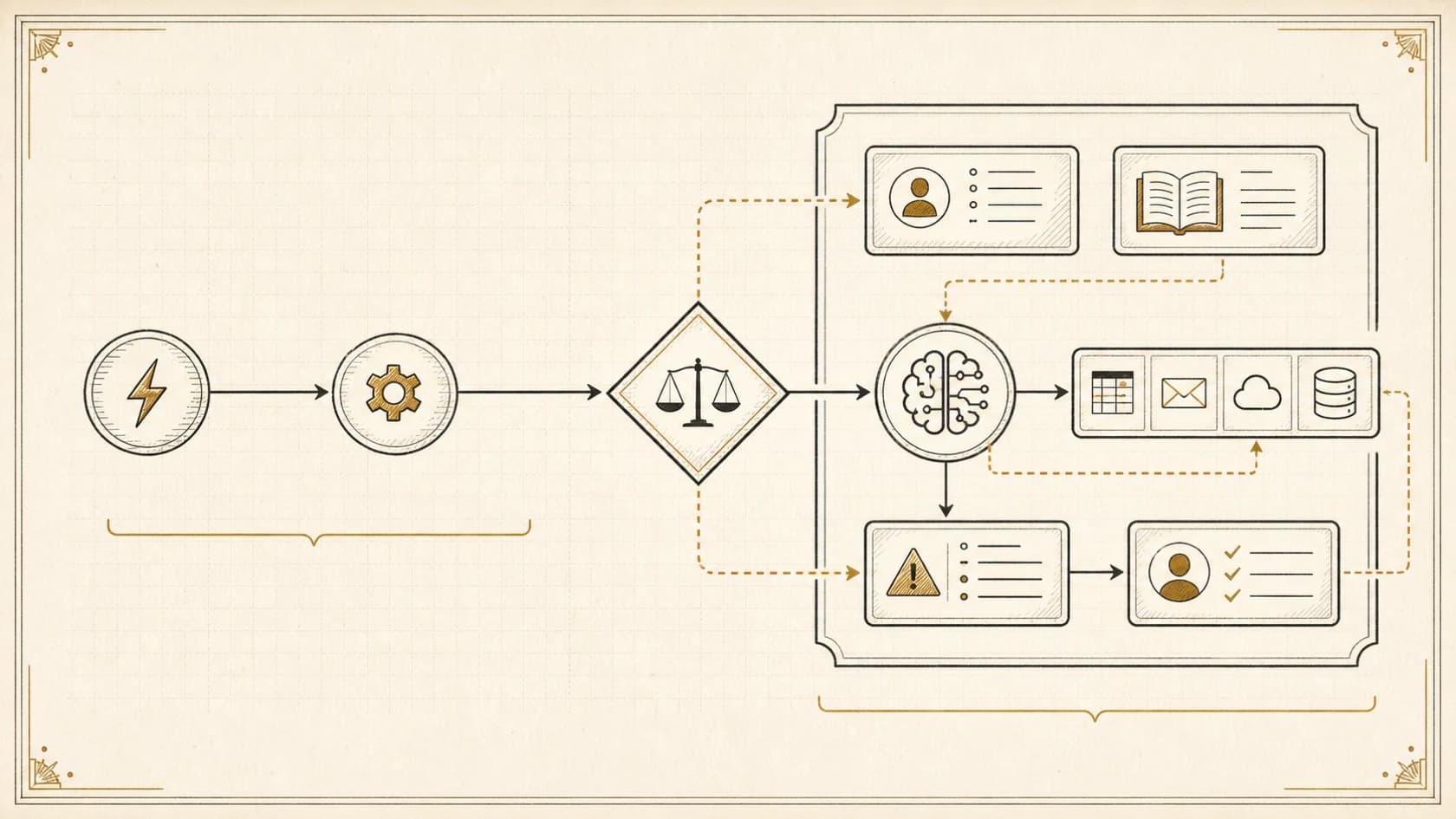
Some steps should remain ordinary rules: validating required fields, moving a known file, calculating a due date, checking a status, or writing a structured record. AI is useful when the work involves language, classification, retrieval, summarization, or bounded recommendations.
A strong design uses the simplest reliable mechanism for each step. It does not use a model for deterministic policy or use rigid branching where real language understanding is required.
Ask the provider to show which steps are deterministic, model-assisted, human-approved, or human-only. This makes cost, testing, and failure behavior easier to understand.
4. Make exceptions part of the main design
Every real process has missing information, conflicting records, duplicate events, unavailable owners, system outages, policy exceptions, and unusual customer situations.
For each exception, define detection, safe state, visible queue, owner, permitted resolution, and reconciliation. “A human takes over” is incomplete unless the human receives the context and has a tool to resolve the state.
Automation should fail closed when an action could create material customer, financial, privacy, or operational consequences. Lower-consequence work may safely queue and retry under bounded rules.
5. Inspect security, data, and access boundaries
The provider should inventory credentials, data classes, systems, vendors, retention, and access paths. Use least privilege. Separate development and production where appropriate. Keep secrets out of prompts, logs, and documentation.
Ask who can view customer data, recordings, transcripts, and generated outputs; where they are stored; how long they are retained; and how access is removed. Obtain appropriate legal and security advice for regulated or sensitive workflows.
Every external message and consequential write should be attributable to the source data, rule, version, actor, and approval state.
6. Demand end-to-end acceptance testing
A connector test proves two tools can exchange data. It does not prove the business process works.
The provider should test representative normal cases, every important edge case, system failures, retries, duplicate events, stale data, human changes during execution, permission denial, and prohibited actions. Verify final system state and human handoff, not only a success log.
For AI-assisted steps, test factual grounding, source use, uncertainty, instruction following, and business appropriateness. Keep a regression set so later prompt, model, data, or integration changes do not silently reopen known failures.
7. Clarify ownership after launch
Ask who owns monitoring, incident response, knowledge updates, policy changes, integration changes, vendor changes, access review, cost review, and acceptance-set maintenance.
The client may own some roles and the provider may own others. The important thing is that the boundaries are explicit. The managed-agent ownership guide offers a detailed contract for this ongoing responsibility.
Avoid a design that only the original builder can understand. Require readable workflow documentation, source inventories, runbooks, decision records, and a controlled change process.
8. Evaluate the commercial case honestly
Estimate current effort, waiting time, error recovery, missed follow-through, and risk using available evidence. Model the expected effect with assumptions visible. Include implementation effort, ongoing operation, vendor costs, review time, and change management.
Treat the model as a decision aid, not a promise. Use a pilot or bounded launch to collect real operating evidence. Continue, revise, or stop based on observed performance and the company’s priorities.
Also ask how the provider will separate time saved from work merely shifted elsewhere. An automated intake may reduce one person’s effort while creating a larger review queue for another team. The baseline and pilot should follow the work across the whole function, including exception handling, correction, customer communication, and supervision. A useful result improves the system rather than one isolated task counter.
9. Provider selection checklist
The AI assessment process is Return My Time’s starting point for this work. If you have a repeatable process with meaningful inbound volume, scattered knowledge, or slow response, apply for an assessment. We review each application for a legitimate business and a concrete, repeated bottleneck.