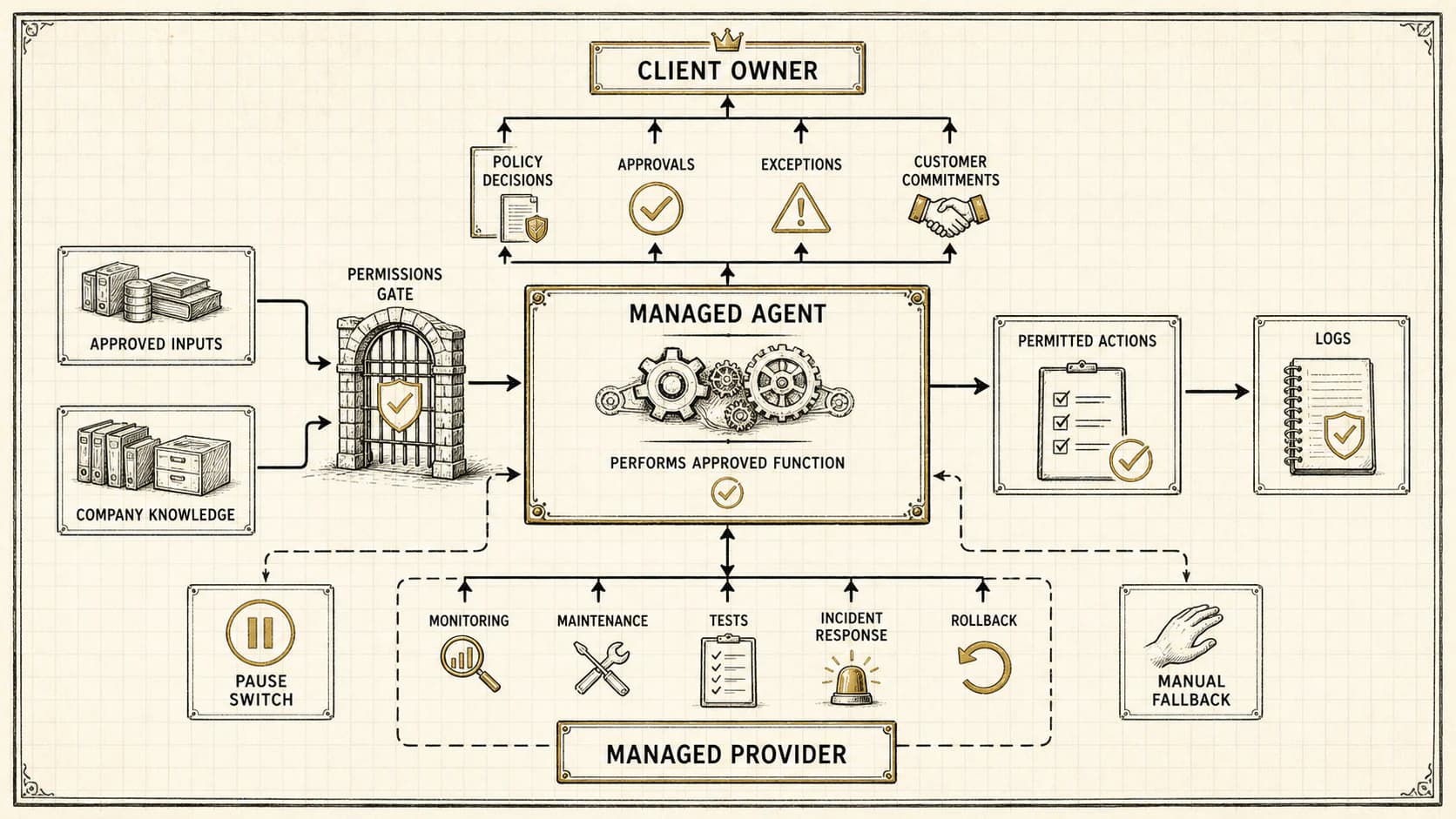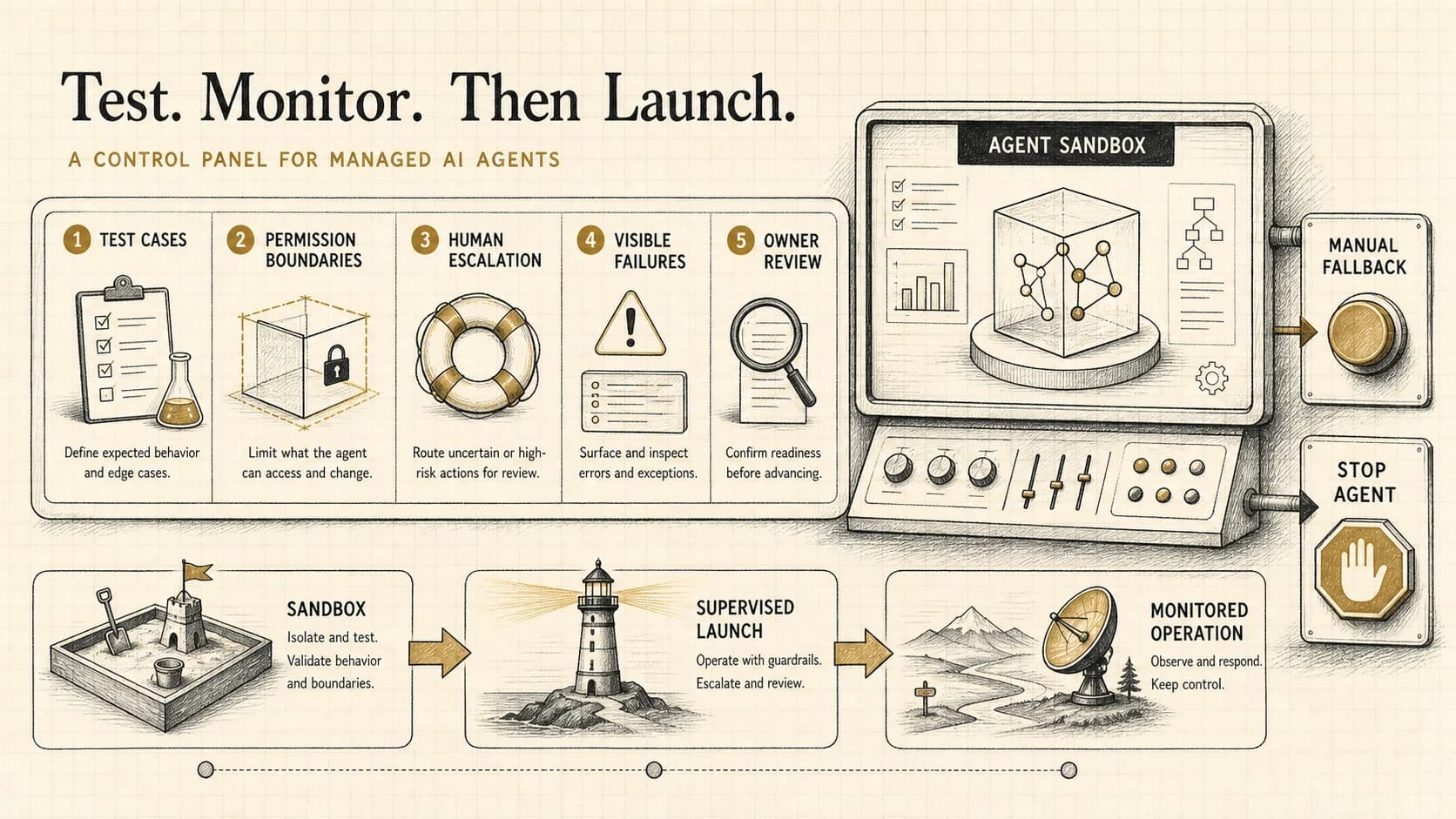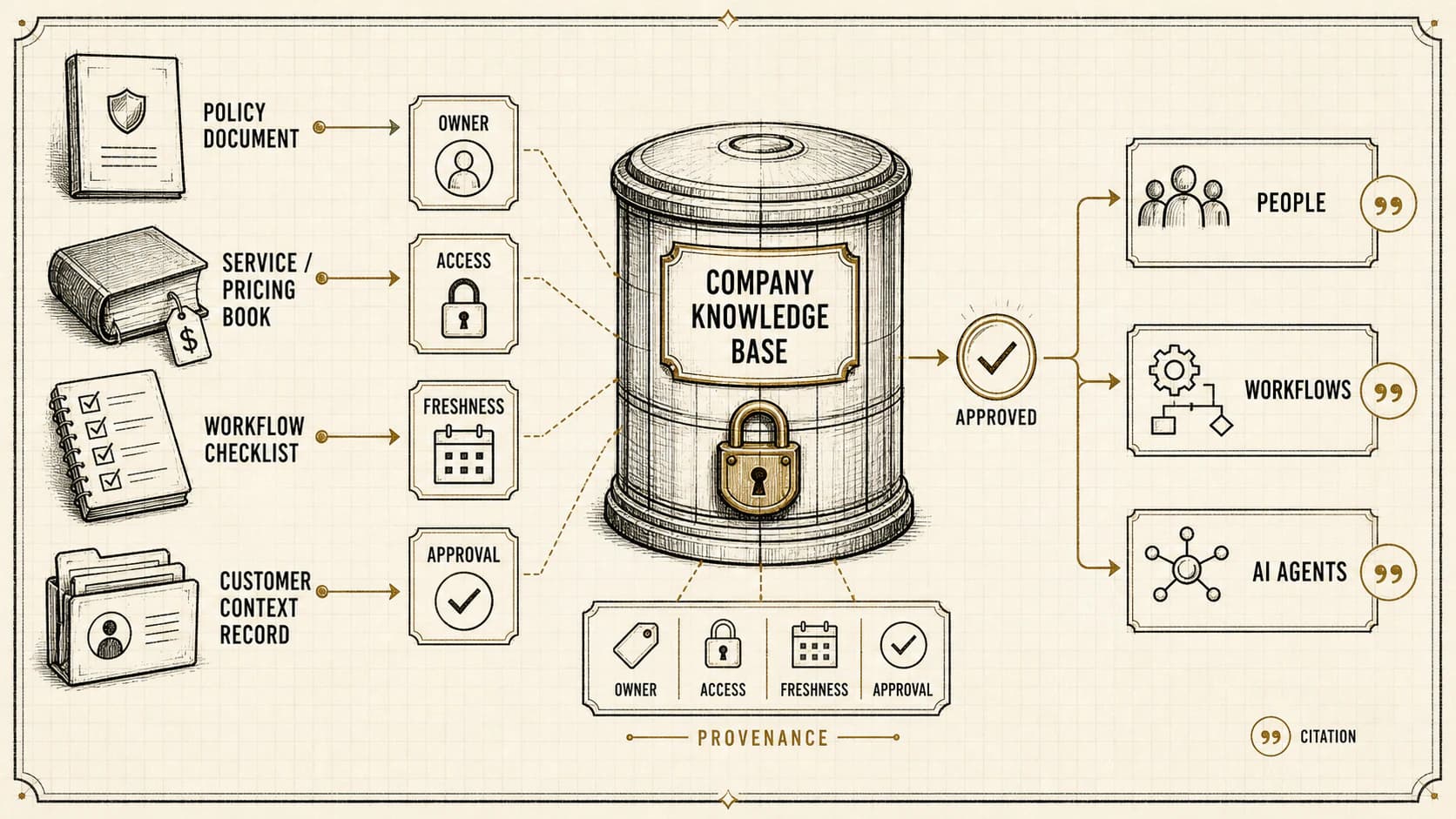

AI agent development services should produce a reliable business function with controlled access, observable decisions, safe handoffs, and ongoing ownership. The product is not an animated chat box or an agent that succeeds once on a prepared demo.
Buyers can evaluate providers more clearly by asking what the agent is responsible for, what evidence it uses, what authority it has, how it fails, and who operates it after launch.
1. Buy a function, not a general employee claim
Define the job as a bounded input-to-outcome contract. “Sales agent” or “operations agent” is too broad.
A useful function statement might be: receive an inbound service inquiry, verify required information, apply approved qualification rules, create a complete record, and route it to the correct owner; escalate conflicts and exceptions without making customer commitments.
| Contract part | Buyer question | Weak answer |
|---|---|---|
| Trigger | What starts the work? | “It works proactively” |
| Inputs | Which facts and systems may it use? | “Anything it can find” |
| Decisions | Which rules or judgments apply? | “The model figures it out” |
| Actions | What may it read, write, or send? | “Full access is easier” |
| Exceptions | When must it stop or escalate? | “A human can check later” |
| Completion | What proves the function is done? | “The run succeeded” |
The clearer the contract, the more meaningful the proposal and acceptance test become.
2. Inspect the knowledge architecture
Ask how the agent finds current business facts and policies. Reliable knowledge needs approved sources, hierarchy, metadata, ownership, versioning, retrieval, citations, and a publishing process.
Separate instructions from knowledge. Instructions define role, boundaries, tool use, and behavior. Knowledge supplies current facts. Mixing both into one large prompt makes updates and audits difficult.
The company knowledge base guide explains the foundation. A provider should also show what happens when sources conflict or no source supports an answer. “I don’t know, here is the handoff” is often the correct behavior.
3. Require a permission model
List every system and action. Distinguish read, recommend, draft, create, update, send, approve, merge, delete, and administer. Grant the least authority needed for the specific function.
Start with observation or recommendation. Expand permissions after the agent passes acceptance tests. Keep high-consequence actions behind deterministic policy or human approval.
Credentials should be scoped, stored securely, rotated, and removable. The provider should explain data handling, logging, retention, and access for its staff and vendors. Obtain specialist advice where the workflow involves regulated or sensitive information.
4. Evaluate integrations as business state transitions
An agent can call an API successfully and still leave the business in the wrong state. A lead may be created twice, an appointment may exist without a CRM record, or a message may send after a human changed the case.
Require stable identifiers, idempotency, pre-write state checks, attribution, retries, and reconciliation. Define the source of truth for each field and what happens when systems disagree.
The development service should test degraded modes: unavailable CRM, rate limits, partial writes, expired credentials, stale data, delayed events, and manual edits during execution.
5. Demand an acceptance contract before launch
The test set should represent normal work, edge cases, failure modes, and prohibited actions. Use sanitized examples from the business rather than generic benchmarks alone.
Score factual grounding, correct state, permitted action, customer language, handoff completeness, and final records. Include adversarial or confusing inputs that could push the agent beyond its role.
The managed-agent testing guide describes how acceptance tests become regression tests and production monitors. If a provider cannot explain how a known failure stays fixed, the service is not ready for ongoing operation.
6. Inspect observability and human control
Operators need to know what the agent did, why, from which sources, under which rule and version, with which tool result, and what remains unresolved. Logging raw model text alone is not enough.
Require visible queues for missing information, conflicts, failed actions, approval requests, and reconciliation. A human takeover should receive the context and be able to stop, correct, retry, or complete the work safely.
Corey’s discussion of managed agent infrastructure is useful context for why reliable operation includes memory, tools, watchdogs, and containment rather than prompt quality alone.
7. Clarify maintenance and change management
Models, vendors, APIs, credentials, business policies, staff, offers, and knowledge all change. Ask who notices each change, tests it, approves it, deploys it, and rolls it back.
The service should maintain a versioned acceptance set, change record, incident procedure, source inventory, and ownership map. Review costs and performance at the function level.
The managed-agent ownership guide outlines the questions to settle around data, credentials, documentation, termination, and portability.
8. Compare proposals on evidence
Providers may use different models and platforms. Compare them on the operating requirements that survive those choices:
- clarity of the business-function contract;
- quality and maintainability of knowledge;
- permission and approval design;
- integration integrity and reconciliation;
- acceptance coverage and demonstrated failures;
- observability and human takeover;
- launch boundary and rollback;
- ongoing roles, response model, and client access.
Ask for demonstrations using representative scenarios and explicit expected outcomes. A polished conversation is not enough.
Compare the provider’s explanation when a scenario fails. A credible team should be able to identify whether the cause was source quality, retrieval, policy, model behavior, tool execution, permissions, or workflow design. The proposed correction should include a regression case and a controlled release path. Reliability comes from that learning loop, not from claiming the agent will never make a mistake.
9. AI agent development services checklist
The best provider is not necessarily the one promising the broadest autonomy. It is the one that can show how a valuable function becomes safe, observable, and maintainable. If you are considering AI for a recurring business workflow, apply for an assessment to identify the opportunity worth doing first.