

A long list of AI ideas is not a roadmap. It is an inventory.
The Effort versus Impact Matrix is a useful first filter, but it cannot tell you whether a project has a responsible owner, usable data, acceptable risk, or a definition of done. Those questions decide whether an attractive idea is ready to implement.
For a service business with steady inbound, the difference matters. “Automate lead follow-up” may look high impact. But if nobody owns the response rules, lead sources are inconsistent, or the team cannot handle exceptions, a fast automation can create a faster reliability problem. The revenue opportunity is real; so is the need for operational ownership.
Start with effort and impact
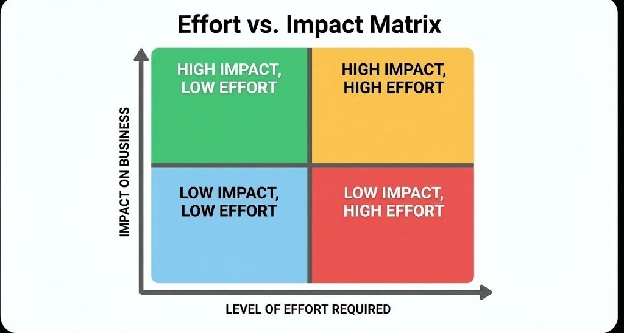
Place each candidate on two axes:
- Effort: implementation time, integration complexity, policy work, training, and ongoing maintenance.
- Impact: revenue protected or created, company knowledge retained, service quality improved, or meaningful capacity released.
The four quadrants remain useful:
- High impact, low effort: investigate first.
- High impact, high effort: plan and resource deliberately.
- Low impact, low effort: delegate, batch, or leave manual.
- Low impact, high effort: decline.
Do not turn the top-left quadrant into an automatic “build now” list. Run each candidate through the readiness checks below.
The seven-factor readiness scorecard
1. Business impact
Name the business result in plain language. Good answers include:
- respond to qualified inquiries consistently;
- keep delivery knowledge when a team member is unavailable;
- reduce missed handoffs between sales and operations;
- make a recurring report more reliable.
“Use AI” is not an outcome.
2. Implementation effort
Count the full effort, not only configuration. Include source cleanup, permissions, testing, training, monitoring, and exception handling. A ten-minute demo may still lead to an owned production system.
For low-risk learning, start with one of these four contained AI experiments. They help you learn without confusing a demonstration with a finished business process.
3. Named owner
One person must be accountable for:
- approving the workflow;
- reviewing exceptions;
- updating rules and source material;
- deciding when the system should pause.
“The team” is not an owner. A vendor can manage the system, but someone inside the company still owns the business decision.
4. Data readiness
Ask:
- Where does the source information live?
- Is it current and complete?
- Which system is authoritative?
- Does it contain client, employee, payment, or regulated information?
- Which accounts and policies approve its use?
Scattered knowledge is often the real constraint. Automation built on conflicting documents simply produces conflict faster.
5. Risk and reversibility
Separate low-risk drafting from high-risk action.
An internal draft that a person reviews is easier to reverse than an automatic client promise, payment action, record update, or deletion. The higher the consequence, the stronger the approval, logging, fallback, and access controls should be.
6. Volume and frequency
Measure how often the work occurs. A small annoyance repeated 100 times a month may deserve attention before an impressive task performed twice a year.
For lead operations, count qualified inbound by source, current response patterns, and the points where ownership breaks. Do not invent revenue recovered. Use your own lead volume, close rate, and average value to decide whether the opportunity is material.
7. Acceptance criteria
Write the test before choosing the tool. Examples:
- Every test lead creates one complete record and alerts the assigned owner.
- The response uses only approved service-area and scheduling information.
- A failed handoff is visible within a defined time.
- A draft procedure can be followed successfully by someone other than its author.
If you cannot describe an acceptable output, the project is not decision-ready.
A simple decision table
| Question | Ready | Not ready |
|---|---|---|
| Is the business result specific? | Measurable outcome | General interest in AI |
| Is the source information usable? | Current source of truth | Scattered or conflicting inputs |
| Is the owner named? | One accountable person | “The team” |
| Is the risk bounded? | Review, fallback, permissions | Irreversible action without controls |
| Is volume known? | Observed frequency | Assumption |
| Is success testable? | Written acceptance criteria | “It feels better” |
When several answers land in “not ready,” the next move is discovery and process cleanup—not buying another tool.
Choose the right implementation path
Use a simple do-it-yourself tool when the workflow is deterministic, low-risk, and easy for your team to own. The Zapier automation guide shows that boundary in practice.
Use a staged workflow plan when the work is understood but the team needs a sequence. Start with the workflow-first AI implementation guide.
Consider managed implementation when the workflow is revenue-critical, crosses multiple systems, contains sensitive information, or lacks an internal technical owner. The value is not merely configuration. It is design, testing, monitoring, exception handling, and clear accountability. Return My Time’s services are designed for operators who prefer that work handled for them.
Your next 20 minutes
- List five recurring operational problems.
- Plot effort and impact.
- Score the strongest two across owner, data, risk, frequency, and acceptance criteria.
- Choose one next decision: decline, gather evidence, run a contained trial, or prepare for implementation.
If you want help finding the best starting point, request a free AI Opportunity Assessment. The goal is not to automate the most exciting problem. It is to choose a valuable problem that your business is ready to own.