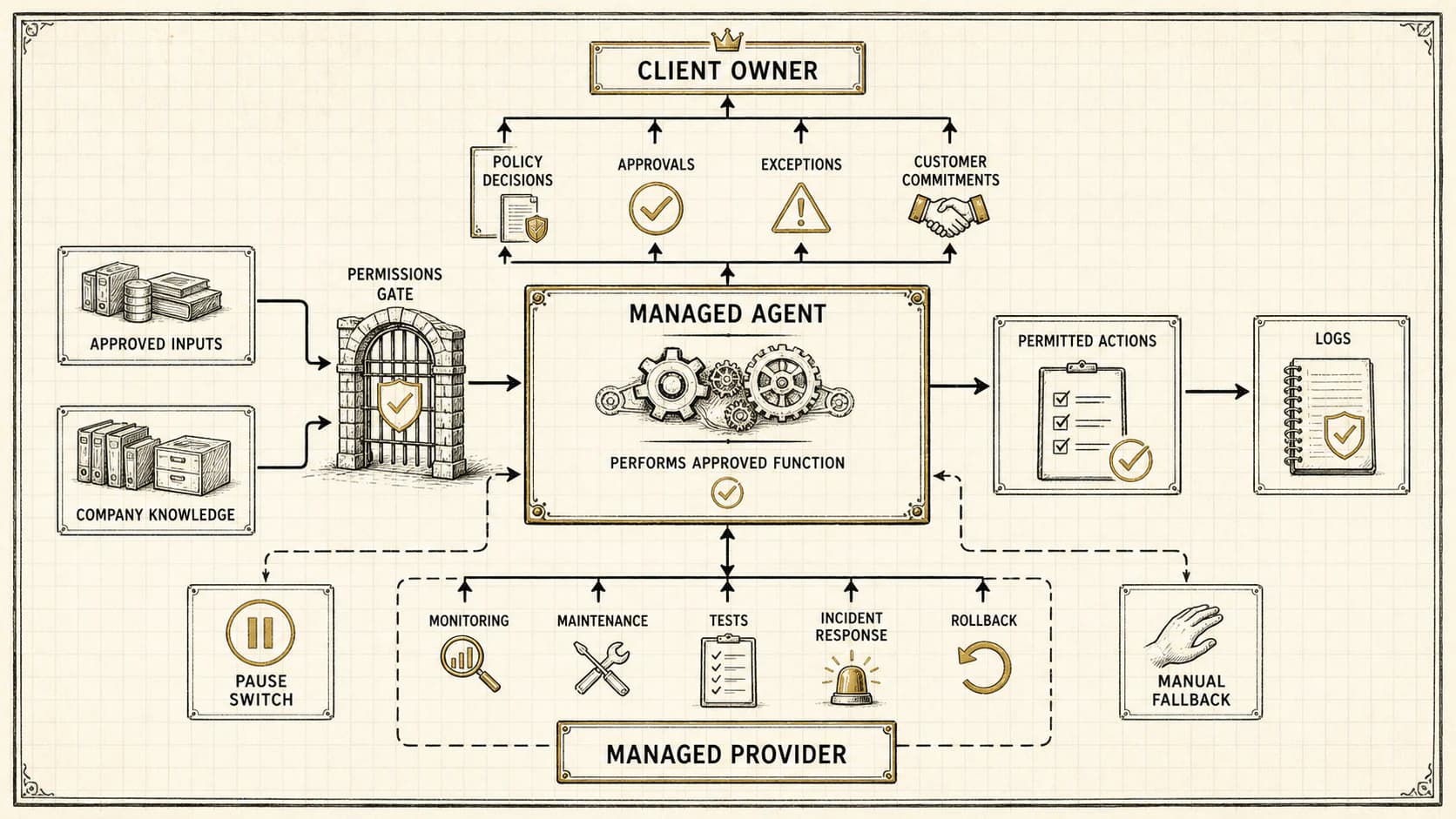
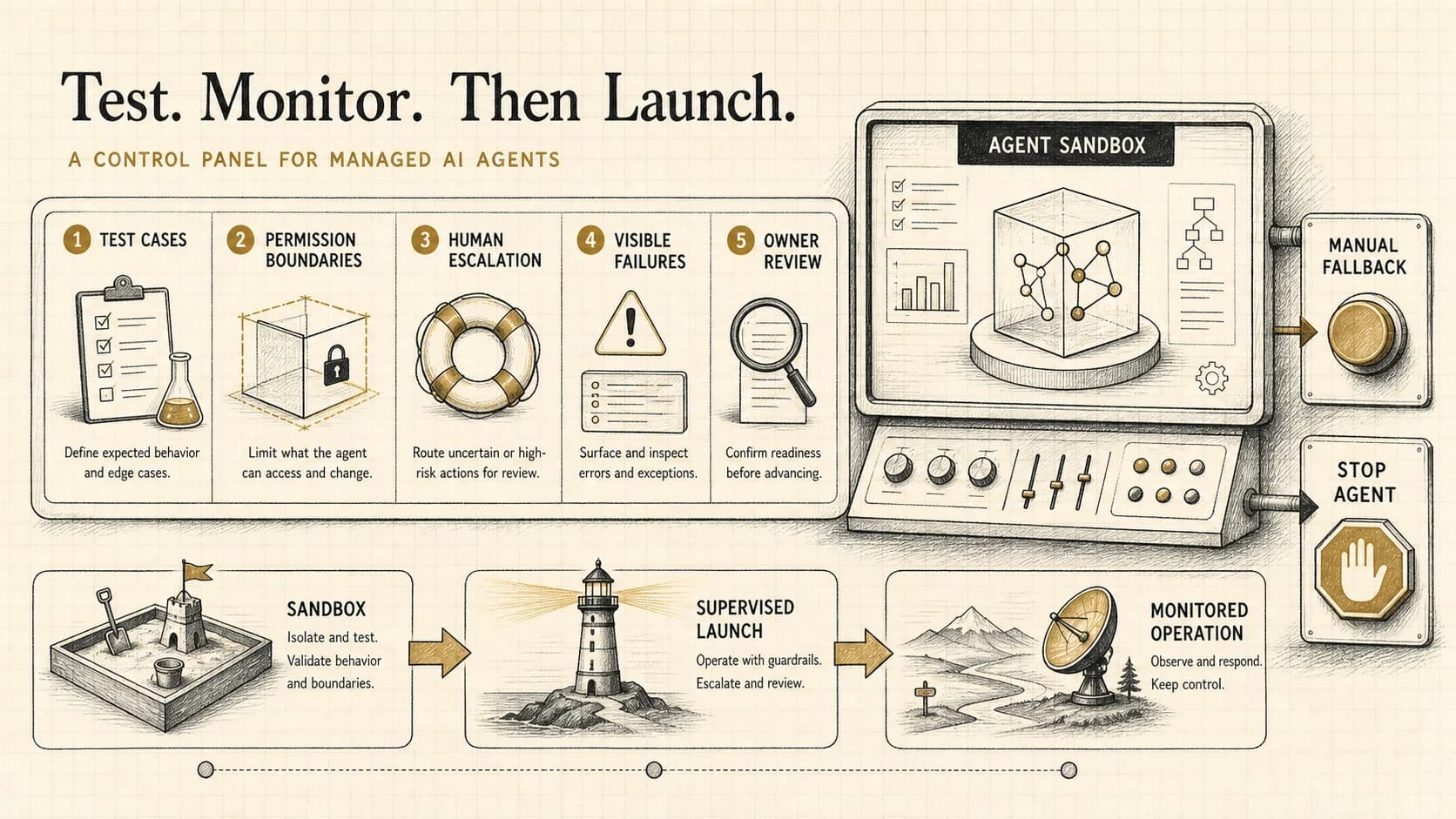
A managed AI agent is ready for live work when it passes defined acceptance cases, stays inside its permissions, escalates uncertainty, exposes failures, and can be paused without losing the business process. Monitoring must show whether the function completed correctly—not merely whether the software is online.
That standard is stricter than a successful demo. A demo usually shows one intended path with cooperative data. Live work includes missing information, conflicting sources, repeated events, unavailable tools, changed permissions, unusual customers, and people who make corrections mid-process.
Testing establishes what the agent is allowed and expected to do. Monitoring shows whether that contract continues to hold. Incident response and reconciliation explain what happens when it does not.
1. Define success before testing the agent
Begin with one bounded business function. The managed-agent ownership guide recommends defining inputs, decisions, outputs, completion, non-goals, and escalation before assigning authority.
Turn that operating contract into observable acceptance criteria.
For a lead-routing agent, success might mean:
- every eligible inquiry creates one complete internal record;
- the published qualification rules are applied;
- the selected owner and reason are visible;
- uncertain or high-consequence cases reach a named reviewer;
- prohibited promises are never sent;
- failed writes become visible and can be reconciled;
- a retry does not create duplicate leads or messages.
“The output looks good” is not an acceptance criterion. Neither is “the agent completed the task” if completion cannot be verified in the business system.
Define evidence for each criterion. That might be a CRM record, message status, approval log, source citation, queue entry, or reconciliation report. Name who accepts the evidence and who may waive a failed case.
2. Build normal, edge-case, and prohibited-action tests
A useful test set represents the operating range, not only the happy path.
Use three classes:
| Test class | Purpose | Example |
|---|---|---|
| Normal | Prove the intended repeatable function | Complete qualified inquiry routes to the correct owner |
| Edge and failure | Prove behavior under uncertainty or degraded tools | Required field missing, CRM unavailable, owner map conflicts |
| Prohibited action | Prove the boundary holds | Agent refuses to promise an unapproved price or delete a record |
Build cases from actual workflow variation, stripped of sensitive customer information. Include:
- complete and incomplete inputs;
- common synonyms, formats, and attachment types;
- current, stale, and conflicting sources;
- each approved exception;
- ambiguous identity and duplicate events;
- tool timeout, partial write, retry, and delayed response;
- a human edit occurring during execution;
- changed permissions or expired credentials;
- requests outside the function;
- adversarial or irrelevant instructions inside inbound content.
Every test needs expected inputs, permitted sources, expected decision, expected action, prohibited actions, evidence, and pass/fail conditions.
Avoid tuning only to a fixed test set. Keep a stable regression set for known requirements and a separate review set that changes. The stable set detects regressions; the rotating set tests generalization within the approved function.
3. Verify sources and permissions
An agent can produce a plausible result from the wrong source. Acceptance must therefore test provenance as well as wording.
For important decisions, verify:
- the source is approved for the function;
- the version and effective date are current;
- customer-specific material is applied only to the right customer;
- examples do not override policy;
- conflicting sources trigger the published precedence or escalation rule;
- restricted content is not exposed to an unauthorized route.
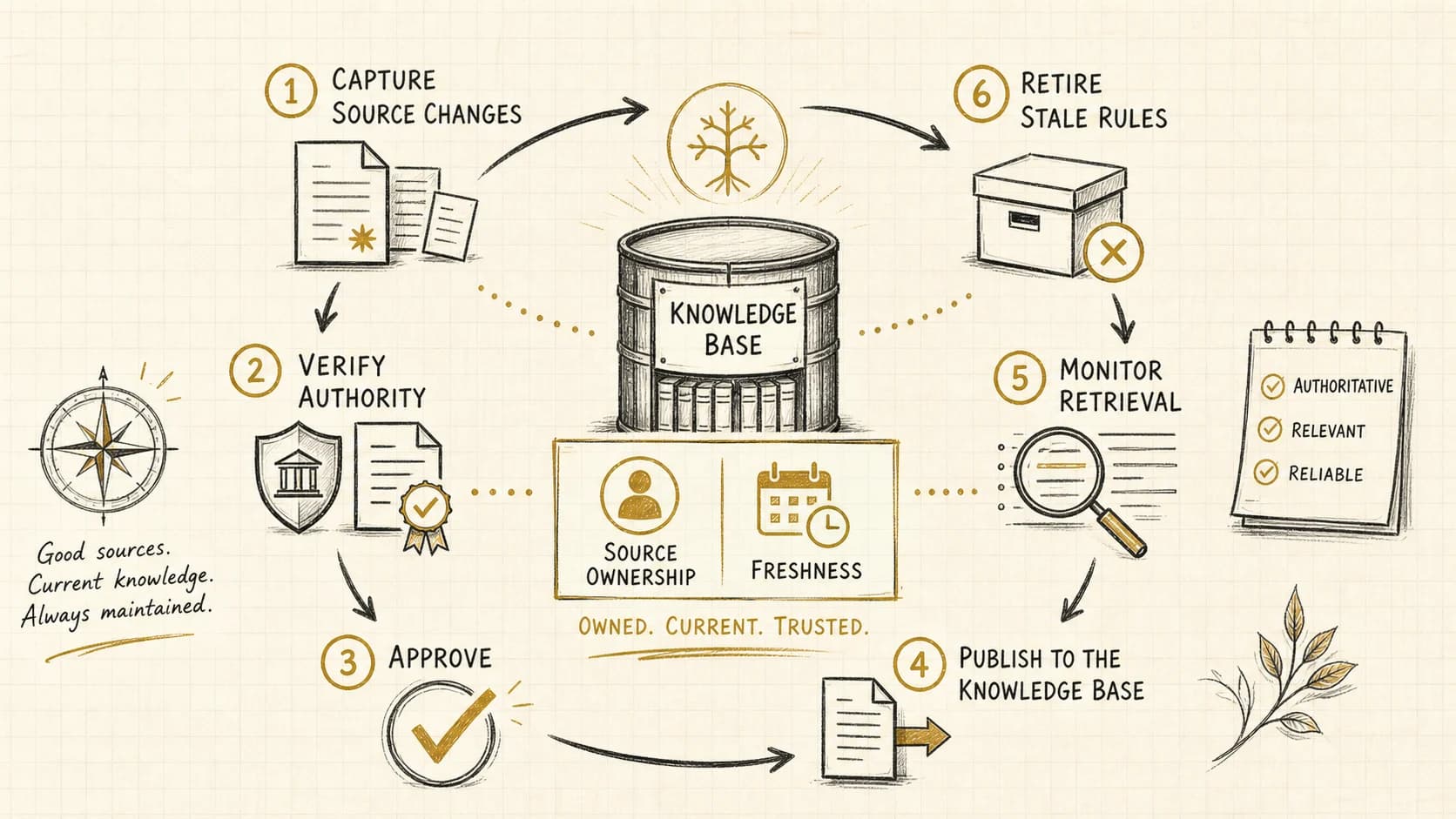
The knowledge-maintenance guide covers how source ownership, freshness, conflicts, and retirement remain controlled after launch.
Permission tests should begin from least privilege. Test read, draft, write, send, modify, delete, approve, and administer authorities separately. An integration that technically supports an action does not mean the agent needs it.
For each account or tool, record:
- the identity used;
- scopes and resources available;
- allowed actions;
- approval thresholds;
- credential owner and rotation path;
- logging and alerting;
- revocation and offboarding;
- expected behavior when access is removed.
Attempt prohibited actions in the test environment. A written boundary that has never been challenged is only an intention.
4. Test approvals, escalation, retries, and duplicate handling
Human-in-the-loop behavior must be tested end to end.
An escalation should include the input, relevant sources, the decision attempted, why the agent stopped, the available options, and the consequence of delay. The reviewer should not have to reconstruct the case across five systems.
Test:
- the primary reviewer receives the request;
- approval, rejection, and requested revision each produce the correct next action;
- the backup route works;
- expiry or no response leads to a safe state;
- a late approval cannot revive a cancelled or superseded action;
- the final record shows who decided and what was authorized.
Retries need idempotency. Simulate a response that succeeds in one system but times out before confirmation. The agent should check current state before repeating the action. Otherwise a temporary failure can create duplicate messages, invoices, leads, tasks, or customer commitments.
Duplicate handling should cover repeated webhooks, customer resubmissions, matching records, and concurrent human work. Define which identifier establishes sameness and what happens when the match is uncertain.
5. Launch in stages with a manual fallback
Do not move from isolated test to unrestricted production in one step.
A staged launch can use:
Sandbox
Run synthetic or sanitized cases against non-production accounts. Prove logic, source selection, permissions, failure behavior, and evidence collection.
Shadow mode
Process live inputs without taking the business action. Compare recommendations with the team's actual decisions. Record differences and classify them as missing knowledge, unclear policy, workflow variation, agent error, or human inconsistency.
Draft mode
Let the agent create drafts, summaries, or proposed CRM changes for approval. Verify reviewer usability and queue operations.
Limited live authority
Enable a narrow, reversible action for a defined segment, volume, schedule, or owner. Keep higher-consequence actions behind approval.
Monitored operation
Expand only after the acceptance set passes, live evidence matches the contract, incidents can be handled, and the business owner approves the next boundary.
Each stage needs entry criteria, exit criteria, duration or sample conditions, stop authority, and rollback. “No one complained” is not an exit criterion.
Maintain a manual fallback that the team can actually use. Document how work is captured while the agent is paused, how the backlog is reconciled, and who authorizes restart.
6. Monitor outcomes, not only uptime
Infrastructure health matters, but a green service can still produce incomplete business work.
Monitor at four layers:
| Layer | What to observe |
|---|---|
| Availability | Agent, model, integrations, queues, credentials, and source access |
| Execution | Started, completed, retried, timed out, duplicated, or blocked work |
| Decision quality | Source use, rule application, overrides, exceptions, and prohibited actions |
| Business reconciliation | Expected records, messages, approvals, and next actions agree across systems |
Useful signals include queue age, unresolved exceptions, approval backlog, source freshness failures, repeated tool errors, retry volume, duplicate prevention, manual overrides, and the last successful reconciliation.
Alert thresholds should reflect consequence and expected volume. One failed high-value commitment may deserve immediate attention while a low-risk internal summary can wait in a retry queue.
Logs must support investigation without exposing unnecessary sensitive content. Record identity, time, action, source reference, decision, result, and correlation identifiers. Apply retention and access rules appropriate to the data.
Corey's June 22 managed-agent episode discusses templates and watchdog alerts. The July 27 episode shows examples of agent infrastructure, provisioning, and observation interfaces. Those demonstrations support the need for managed operations; they do not independently prove customer outcomes, security, or complete autonomous delivery.
7. Reconcile failures and control restart
An incident is not resolved when the technical process starts running again. Determine which business records may be missing, duplicated, stale, or incorrect.
The response plan should name:
- who can pause the agent;
- who investigates the technical failure;
- who owns the affected business records;
- how new work is handled during the pause;
- how the affected time range and records are identified;
- how corrections are reviewed and applied;
- what tests must pass;
- who authorizes restart;
- how recurrence is prevented.
Use correlation identifiers to connect the input, decisions, tool actions, records, messages, and retries for one unit of work. Reconciliation can then compare expected and actual state.
After a significant failure, add a regression test that would have caught it. Review whether the root cause was software, integration behavior, stale knowledge, unclear policy, permission drift, capacity, or an unhandled exception.
Restart with the smallest safe authority. Do not assume the old operating boundary remains appropriate after the incident.
8. Give the owner a useful monthly report
The owner needs evidence of work, exceptions, reliability, and required decisions—not a page of model tokens or generic activity counts.
A practical report can include:
- work received, completed, awaiting approval, and unresolved;
- completion and queue time against the company's agreed operating target;
- exceptions grouped by reason and owner;
- failures, customer-impact review, and reconciliation status;
- human overrides and what changed as a result;
- knowledge sources updated or flagged as stale;
- permission or integration changes;
- tests added, failed, and restored;
- recommended rule, workflow, or scope decisions;
- open risks and the person accountable for each.
Separate facts from recommendations. “Twelve cases awaited a pricing exception” is an observation. “Create a new approval tier” is a proposed decision.
Do not convert a short sample into a commercial outcome claim. Compare against the company's baseline and note changes in volume, process, staffing, or policy that affect interpretation.
9. Managed-agent acceptance checklist
Return My Time does not currently have a measured managed-agent client case study. This is an operating and buying standard, not a guarantee of autonomy, savings, revenue, or reliability.
If a business function is important enough to manage and specific enough to test, apply for an assessment. We’ll identify the strongest opportunity and whether an existing tool, connected knowledge, or a custom AI skill fits.